Burton Silverman is one of the premier portrait painters in the world today.
Tuesday, January 12, 2021
THE JOURNALIST ILLUSTRATORS: BURT SILVERMAN
Sunday, January 10, 2021
THE JOURNALIST ILLUSTRATORS, part 1
Before cell phones converted every citizen into an amateur news photographer it was popular to employ illustrators as visual reporters. Artists such as Burt Silverman, Daniel Schwartz, Marshall Davis, Hank Virgona, Robert Weaver, Harvey Dinnerstein, Franklin McMahon, Tom Allen, Paul Hogarth, Stan Hunter, and Harvey Schmidt were regularly assigned to create drawings to accompany news articles when photographs were unavailable or inadequate.
![]() |
| Burt Silverman |
![]() |
| Daniel Schwartz illustration for an article on Watergate |
![]() |
| Hank Virgona illustration for an article on a jury's deliberation |
Journalist illustrators appeared in magazines such as Life, Newsweek, Fortune, Holiday and Sports Illustrated regularly.
![]() |
| Marshall Davis illustrates an article on night court for Life Magazine |
![]() |
| Feliks Topolski records the streets of Chunking |
Art like this, commissioned for reportorial purposes, tended to be forgotten as soon as the news became old. But many talented artists contributed to this body of work, and they often came up with interesting and creative solutions.
That's why, over the next several days, I'm going to offer up art by several of these artists who I believe are worth a second look. I hope you'll agree.
Wednesday, January 06, 2021
AFTER WORDS HAVE BEEN EXHAUSTED, DRAWING RETAINS ITS POWER
As Donald Trump gracefully exits the presidency, the blizzard of words over the 2020 election continues unabated. Rival versions of reality bark, blabber and chirp uselessly at each other from competing cable news sources. Facts gain no traction with people who believe whatever they need to believe in order to get by.
The famous linguist S.I. Hayakawa wrote, "Long before we developed language as we know it, we probably made, like the lower animals, all sorts of animal cries, expressive of such internal conditions as hunger, fear and triumph." Hayakawa explained that our ancient ancestors used sounds for tribal communion rather than to communicate objective information. Today, people daunted by the burdens of civilization have abandoned the meaningful use of objective words and retreated to pre-symbolic utterances.
Ah, but even before our ancestors developed language they had images. Now as words lie exhausted by the side of the road, pictures still retain their ancient magic. People have figured out that words lie-- a good vocabulary and grammar can be misdirected by any con man, pimp or president-- but good drawing doesn't lie; its integrity can't be separated from its line.
Which brings me to this drawing by the talented political cartoonist Ann Telnaes:
By understanding line, color and composition Telnaes has designed a strong, effective picture with unity and integrity. Note the elements that she brings together here: the composition has the energy and force of an arrow. She uses the high contrast / dark color at the tip of the arrow, penetrated by that bright red zig zag tie, to start our eye exactly where she wants it. Once we're there, the artist establishes her initial joke with father time. (She also shows that she knows know how to draw deranged eyes.)
Both the design and the content are enhanced by her ability to abstract the human form into a rubbery trapezoid (perhaps a legacy from her years at Disney?)
From that starting point she leads our eye into a widening trail of disaster.
Telnaes knows enough perspective to foreshorten the trail leading up to the trapezoid, but a purely realistic, mechanical perspective would've been boring. By distorting the objects with a flair, she gives them an additional snap which keeps us interested from one object to the next.
She also integrates the objects with pattern and design, something too often neglected in modern cartooning:
Rather than join in the fruitless battle of words, Telnaes uses the power of an artist's symbols. She doesn't write an op-ed with psychological explanations for the president's immaturity, she plants a pacifier at his feet and lets the concept unfold from there.
Hundreds of thousands of pages of legal prose have been carefully drafted for more than 60 failed lawsuits around the country, yet those lawsuits are so detached from reality they might as well have said, ceci n'est pas un legal brief. The fact that the lawsuits were universally rejected by judges didn't affect the beliefs of those with no regard for the meaning of words. Telnaes doesn't try to join in the debate of words, she plants a pitcher of Kool-Aid and lets the visual symbol do its work. Viewers are drawn into understanding the significance of the pitcher, and once they've done that they've been tainted by the concept.
In today's debased political vocabulary, calling someone a "liar" has lost its sting. But oboy, those drawings still have a bite, at least judging from the brutes who become so enraged by Telnaes' pictures that they threaten her with violence.
My point isn't that a particular politician is good or bad, my point is that even when language begins to disintegrate as a means of communicating what is real and what is not, drawing has a truth and integrity all its own. We see its power in the way it communicates concepts and the reactions it evokes.
Wednesday, December 30, 2020
THE END OF 2020
For those of you who've somehow succeeded in surviving covid 19, political blood feuds, unemployment, Russian hacking, the economic collapse and dysfunctional government, congratulations!
I'm sure 2021 will be better for us all. Thanks for your participation this year, and here's wishing you a happy, healthy new year.
Friday, December 18, 2020
THE WISDOM OF WIVES WHO POSE NUDE
The war over the relationship between photography and painting has raged for 150 years.
Philosophers have battled with art critics. Artists have feuded with other artists. Photographers have clashed with art directors. Are the two art forms comparable? How heavily may a painter rely on photographs? Thousands of pages have nearly exhausted the subject, but one important perspective has been neglected: wives who pose nude for their husbands.
In her 1933 divorce proceedings against illustrator Everett Shinn, Gertrude McManus Shinn explained the difference between painting and photography to Judge Leonard Nickerson:
I didn’t mind posing for my husband in the nude in his studio, even holding poses for two hours at a stretch.... But when my husband insisted that I also pose in the nude while he brought out a pocket camera I was deeply embarrassed and hurt.She then broke down in tears.
It was altogether unfair and cruel. I simply can’t bear to go on with life if it means living with him.
This distinction between painting and photography was equally obvious to other wives in the community. After Gertrude's tearful testimony, wives rallied around her and expressed their opinions in the local press. They said Gertrude was “absolutely right" and “snapshots are horrid." They believed that unlike photography, painting transformed the facts "underneath the mystery of her clothes" in a way that freed her from shame.
Professional thinkers may see many shades of gray, but for the wives of Westport it was black and white:
One of Mrs. Shinn's friends said,
Of course Mrs. Shinn is right. Husbands of pretty women are always so stupid about failing to understand why their wives volunteer to pose in the altogether for artists but won’t allow anyone, even their own husbands, to snapshot them that way.
She knows that the artist will idealize her, painting out or in as the case may be, such sins of commission or omission as nature perpetrated in her case, so that when the finished canvas is exhibited, there she stands naked and unashamed, in the interest of art, because, all faults being corrected, she sees nothing to be ashamed of.
The snapshot tells the unvarnished, naked truth, which is simply horrid. How could Mrs. Shinn be sure that her husband, with that dumb, masculine honesty that is the despair of all smart women, would not take out that little picture and show it to a group of devoutly admiring men looking at the painting, and spoil everything?
It's not clear whether Gertrude fully persuaded Judge Nickerson about the aesthetic differences between paintings and photography, but he felt the differences were substantial enough to grant her request for a divorce.
Sunday, December 06, 2020
NEW BOOK: A LIFE IN INK BY RALPH STEADMAN
Many years ago, the famous Chinese artist Huang Erh-Nan would fill his mouth with black ink and paint pictures with his tongue.
Ralph Steadman seems to love black ink only slightly less than Huang Erh Nan. Over a 60 year career he has splattered great gouts of dense black ink on his pictures, misted ink through an atomizer and scratched it into the surface with technical drawing tools. He describes this career in his new book, Ralph Steadman: A Life in Ink. The book contains a cross section of his work as a political cartoonist, a cover artist for album covers and movie posters, a children's book illustrator and perhaps most famously for his collaborations with Hunter S. Thompson.
![]() |
| Self portraits by Steadman in 1965 and 2020 |
The self-portrait above of Steadman in his covid mask is the only example I could find in the entire book of Steadman being muzzled. He seems to have started right out of the gate with outspoken, often barbed opinions.
![]() |
| 1967 |
![]() |
| 1975 |
![]() |
| Detail from The Malevolence of War (2001) |
When I spoke with Steadman about his career path, his choices seemed as impetuous as one of his ink splatters:
My first job was as an apprentice at an engineering factory in Liverpool. I went once a week to learn technical drawing. I was drawing straight lines and circles; I was going to do a 5 year apprenticeship but after nine months I had to leave. I couldn't stand it. My mother was very upset. She didn't know what to do with me. I eventually ended up working at Woolworth's as a stockroom boy. My headmaster saw me one day sweeping in front of the store and he looked at me with contempt. He said, "Look at you. You had a good job at de Havilland Aircraft Company and what do you do? End up sweeping the streets of Wales."
Yet, he stumbled across an ad for a correspondence art class and his long career was launched.
![]() |
| Book cover for Animal Farm |
![]() |
| Slash |
In addition to hundreds of pages of art showing the evolution of Steadman's style, the new book contains photographs from Steadman's life and an interesting interview discussing his philosophy.
At the end, Steadman lists his personal "Honour Roll" which includes his artistic heroes such as Marcel Duchamp, Terry Gilliam, William Hogarth, Anita Kunz, Ronald Searle and Leonardo da Vinci.
Tuesday, November 24, 2020
A HANDFUL OF THUMBNAILS
The thumbnail preliminary sketch is where artists first attempt to capture a spark of inspiration.
Before the layers of refinement have been added, before the details and finishing touches, before the mistakes have been corrected, a concept takes its initial raw form in a thumbnail. Sometimes it's fun and educational to look at pictures in their embryonic state.
Different artists use thumbnails for different purposes. Some seek out the basic poetry of a picture:
| Saul Tepper thumbnail |
![]() |
| John Singer Sargent's thumbnail for his portrait of the Wyndham sisters |
| Harry Beckhoff |
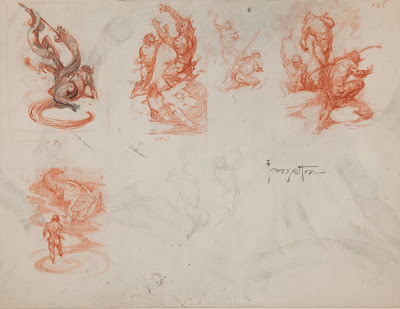
| Frank Frazetta's tiny sketches for his Canaveral series contained all the DNA for his finished pictures. |
Thumbnails can be dense with questions, bad instincts, alternative choices. The artist can afford to be fast and loose because thumbnails require less commitment than any other kinds of picture. They are the most promiscuous form of art, with all the attendant advantages and disadvantages.
Illustrator Robert Fawcett drew six tiny thumbnails on a single card:
Next we see illustrator Dan Content experiment with alternatives for an illustration of a couple in a carriage...
Thumbnails by the classic illustrators often demonstrate a strong sense of priorities and a sharp eye for key details such as the shape of the vase on the table. But the key strength of thumbnails is that they always imply so much more than they show. In many completed pictures the original concept is diminished.
More from Saul Tepper:
Thumbnails are tiny but inch for inch they can be more revealing than the finished picture. Good things can come in small packages.