Sunday, January 05, 2020

WHO ARE ALL THESE ILLUSTRATORS?

I thought I knew a few things about illustration, but looking through boxes of old clippings is a real lesson in humility.  

I must've encountered a hundred capable, hard working illustrators I'd never learned about from the excellent reference books on illustration by authors such as Reed, Taraba, Heller, Watson, Doyle, Grove or Sherman.  

I'm not referring to the anonymous illustrators who come and go; I'm talking about recurring illustrators for major publications, artists who developed a style and signed their work and once upon a time qualified for a byline. 

For example, how many of you have heard of Marshall Frantz?


Or Sydney Seymour-Lucas?


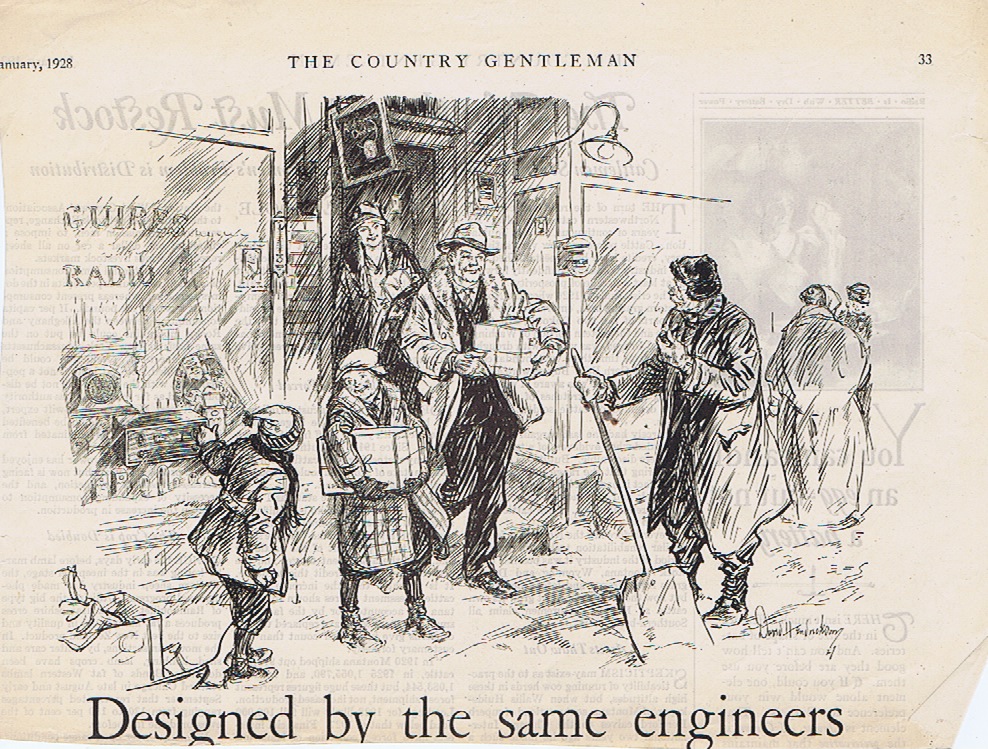
Or David Hendrickson?


Or Douglas Duer?


The list goes on and on.  How many of you are familiar with O.F. Schmidt?


or Jules Gotlieb?


or Armand Both?


or Charles Dye?


or Emmett Watson?


or Robert O Reid?


or W. Smithson Broadhead?


There are so many neglected or forgotten illustrators whose hard earned achievements are preserved today only by yellowing and brittle collections like the one in my basement.


Saturday, January 04, 2020

GLOWING EMBERS IN A DUSTY BOX


Before Instagram, illustrators clipped pictures from magazines, newspapers or any other source they could find.

At the end of a long career, a working artist might  have several file cabinets overflowing with tattered pictures. The pictures usually reeked of decades in an art studio-- rubber cement and ancient cigarette smoke and turpentine mingled with the unmistakable aroma of disintegrating pulp paper.


Sometimes an illustrator would save a picture for its details about a military uniform or the anatomy of a horse.  But often they'd save a picture for higher reasons-- because they admired a creative solution, or a striking use of color, or it sparked an idea for their next project.


These were working pictures, frequently folded or torn, or stained with paint or ink from other jobs.  If you go through a stack you realize how pictures were integrated into the daily life of the illustrator.  It's not unusual to find handwritten notes in the margin about a deadline for a job or a tip about a horse race.  I once encountered a thumbnail sketch on the back of a bar tab.

Some unknown artist tried to work out shadows and folds in the upper left hand corner of this clipping

And you invariably find the kind of nude photos that were traded in the quaint era before internet porn:


More than once I've come across faded polaroids of an artist's own blushing sweetie, taken on some romantic weekend together.

There are files of costumes and files of facial expressions and files of poses.  There is a lot of mediocre and even bad art which was nevertheless clipped because the illustrator saw a redeeming use for some element.

The market value of these files is less than zero-- not enough to pay for hauling the battered scraps to the recycle bin.  Yet, measured by a different standard they have great value.

Artists at the end of their lives seemed reluctant to throw away all those years of choices.  They are like curators who've assembled their own lifelong art collections based on their personal taste and practical needs.   You couldn't ask for a better map of an artist's genome.  And they seem to want to preserve that part of their DNA by passing the torch to some younger person who might still recognize traces of value amongst the inert clutter.


For this reason I've felt honored when old timers-- some of whom  I've lauded on this blog-- bequeathed their clipping files to me before they died.   I have boxes of clippings stacked in my basement.

 Late at night I sometimes dip into those boxes, shake the dust off some of the files and sit down in a comfortable chair to go through them.  I'm guaranteed to end up with a lap full of paper chips.  But here's the interesting thing: when you engage with these pictures and you start to understand why one was clipped, it's like blowing on embers.  They start to glow again and they warm you, no matter how long the embers have been dormant-- in some cases 75 or 100 years.  They can rekindle and communicate something about the taste and judgment of the curator.

For this reason, I am going to post some of these clippings and tearsheets in the days ahead.  Even if they aren't always great art, I hope you will be as charmed by them as I am.

Saturday, December 28, 2019

THE END OF 2019

We've come to the end of another year.  

Specialty drawing by Leonard Starr for the Detroit Press Club in a different era

My sincere thanks to all of you for your interesting comments and suggestions throughout the year, especially for those insults intended to shake me out of my reveries. You've broadened my experience and sharpened my vocabulary, and I appreciate it. 


Here's wishing you a joyful 2020!

Thursday, December 19, 2019

FOUR ARTISTS AND A COMPUTER

This full-page illustration from a recent issue of the New York Times Magazine required the combined talents of four different creators plus a computer: 


The New York Times separately credits the photographer of the tower, the photographer of the trees and the photographer of the vulture, as well as the "illustrator" who glued them all together on a colored background. 

Let's face it, this picture required only limited artistic choices:  which photo of a vulture to pick from the internet? Whether to paste that cupola a little further to the left or the right? How far to push the color balance slider?  These are the art choices of decoupage. 

I welcome the computer as an artistic tool when it enhances an artist's expressive range.  Even added efficiency is a welcome contribution.  But that's not what's happening here.  A capable illustrator using traditional materials could've completed this job in a day.

Why is so much illustration like this today? It fills its allotted space just fine, but what is there to admire about the talents required for this kind of image?  Are we seeing creative responses to genuine artistic challenges?  Are we witnessing the quirks or eccentricities of the human imagination?  Are there any manifestations of admirable manual skill or dexterity or taste?  

The golden age of illustration-- a glorious century in the history of art--  was only made possible by new technologies, but ultimately the age was ushered out again by newer technologies, more efficient but less hospitable to the artistic imagination.  

The golden age began when high quality reproduction, new kinds of paper, better methods of printing and distribution encouraged unprecedented enthusiasm for images.  These innovations spawned a veritable Cambrian explosion, with hundreds of glossy full color magazines creating an unprecedented platform for illustrations.  On this new platform, artistic quality was still tested by what I consider a higher set of artistic challenges: 

  • Artists had to master the hydrology of liquid media (learning to control liquid, but not too much). 
  • Artists had to take tincture from minerals in the ground and wrestle with their obdurate molecules to transform them into the appearance of totally unlike substances: water, clouds, organic matter, light 
  • Artists had to master the physical gestures of art-- impulses that started with the human nervous system and found expression through the wrist, elbow or even the shoulder (as opposed to the touchpad or keyboard).
  • Because they were wrestling with physical media in the physical world, artists had to risk starting over if a picture didn't work out because the consequences of a failure couldn't be contained in a separate Photoshop layer. This gives different meaning to an artist's willingness to gamble and to the psychology of maintaining high standards.

It's no wonder that these artists-- Norman Rockwell, J.C. Leyendecker, Charles Dana Gibson, Maxfield Parrish, Frederic Remington, James Montgomery Flagg, and many others-- were folk heroes in ways that today's "photo-illustrators" can never be.  For all the gross inefficiencies and manual labor involved in working with physical media in the physical world, creativity seems to come out of constrained circumstances.  If you compare the images from these different periods in the history of illustration, it would appear that the process of wrestling with the angel summoned a grander set of choices and commitments.


Wednesday, December 11, 2019

NEW BOOK FROM NATHAN FOWKES

Steve Martin has a comedy routine about how to make a million dollars without paying taxes. "First," he says, "get a million dollars. Then, don't pay the taxes."

I figured that a "how-to" book on painting from Nathan Fowkes would be similar: First, pick up a brush. Then use your exquisite sense of color, your natural gift for design and your light, nimble touch to make a picture."

As a result, I wasn't expecting that his new book would be much more than a portfolio of his watercolors. Still, that was sufficient reason to order it.  The paintings in this book are quite beautiful and the reproduction is excellent (which is crucial for any collection of Fowkes' art).


But I was especially pleased to find a thoughtful book full of practical, insightful suggestions.


For example, I've always admired Fowkes' ability to simplify complex colors and forms, distilling his subjects to their essence.


On this subject, he recommends "finding a simple statement" by honing in on the quality that made you choose to paint that particular scene in the first place, then editing anything that might distract from that quality.  How exactly are we supposed to do that? He offers tips ranging from squinting your eyes, to forcing prioritization by giving yourself a firm 20 minute deadline to paint a complicated subject, or starting with a basic value statement and adding only a few strategic details.  As another exercise in simplification, he talks about limiting your entire painting to 20 brush strokes.

He also offers personal commentary such as his decision to get rid of his TV: "the TV would call to me from the next room, and when the inevitable frustrations of learning something new would hit, the TV was just too tempting of an escape.  I realized I could never have the level of focus that I needed as long as there was a constant distraction right there in the next room."  The book even talks about  dealing with mosquitoes when trying to paint on site.

An excellent book by an excellent artist.

Friday, November 29, 2019

NEW PATENT SAVES YOU FROM THINKING TOO MUCH ABOUT ART

Not long ago, Publishers Weekly made the following claim about the art of Jaime Hernandez:

 "Jaime's ability to sum up life's joy and pain in a few images has never been surpassed in all of art."


I like the work of Jaime Hernandez as much as the next person but this loony sentence might just be enough to topple the human race from our place on the evolutionary tree.

People have become emboldened to say ignorant things because of our current conceit that art is totally subjective.   Personally, I side with Harlan Ellison who wrote, “You are not entitled to your opinion. You are entitled to your informed opinion. No one is entitled to be ignorant.”

When people express silly opinions about art, it provokes the people around them to strain for some kind of rational, objective standard for evaluating art. The problem is, the people who claim to have found scientific standards usually end up in a place equally goofy.

Which brings us to this week's headline: a forensic accountant claims he has developed a computerized technique for identifying Norman Rockwell's artwork.  No longer will you have to judge a Rockwell painting by its artistic merit.

If you research patent #10,460,412 at the Patent and Trademark Office, the inventor claims that in 1940, 
Mr. Rockwell created a blend of Posterization and Steganography, the art of hiding data in a cover medium, to provide an anti-forgery feature to his paintings. He created CMYK paint colors that matched the RGB color model and used the colors he created to hide his initials.
Some of you cynics may be amazed by Norman Rockwell's technical computer skills dating back before the invention of the computer. That shows how little you know. In 1938, the first patent application for "posterization" was filed.  Apparently, when Rockwell reviewed the daily docket for the Patent and Trademark Office he recognized the potential to adapt these nascent technologies into an anti-forgery system for his own paintings:


The patent application claims that using this system, Rockwell was able to conceal his own initials in his paintings to prove their authenticity.  Here are some of the examples of Rockwell's art in the patent application, processed by computer to reveal his hidden steganographic initials:


Note that in one of these examples, Rockwell supposedly wrote his initials "rn" instead of "nr."  No explanation for this is offered.


Based upon this convincing proof, the Patent and Trademark Office granted a patent for this computerized Rockwell detector.

There isn't one character in this process-- including the Patent and Trademark Office-- who wasn't as loony as the claim about Jaime Hernandez.

My point is that we should avoid being coaxed or harassed into either extreme; taste is not totally subjective nor is it objectively provable.  Art continues to demand our highest and best judgment, guided by both reason and passion, on a case by case basis.