Saturday, October 07, 2023

LEYENDECKER: ANOTHER LOOK

A few weeks ago I criticized a museum exhibition and an art critic for their shabby efforts to reduce the great achievement of J.C. Leyendecker to a "gay fifth column." They claimed to see "hidden messages"(such as an erect penis) in Leyendecker's paintings, which they claimed were designed to undermine "the majority's straight erotics." I responded that Leyendecker's work is still under-appreciated, and that a rare exhibition of his originals should acknowledge his broader legacy, rather than serve as a political tool for tiresome people with a narrow agenda.  

Some readers suggested that if Leyendecker deserves broader attention, I should help give him more attention rather than whining about the people who don't.  Fair enough:

It's important to remember that most people became familiar with Leyendecker in an era when printing technology was relatively primitive and full color reproduction was rare.


So when the public is given a chance to view his original paintings, they are surprised by his acute powers of observation and his astonishing technical skills.

Images courtesy of the Kelly Collection of American Illustration

Every artist today would know enough to paint those white highlights, but how many would also notice that the reflected light on the underside of the black beads is a warm color due to her skin, or notice the proper color for the shadow of the beads on her flesh?  More importantly, how many would even care, if their picture was to be reproduced in two colors? 


In books about Leyendecker, we repeatedly see the same pictures of his stylish Arrow collar man, or Kuppenheimer ads, or sports figures.  But Leyendecker did hundreds of quality covers on a variety of topics for The Saturday Evening Post and Collier's that you rarely-- if ever-- see reproduced. 


There's still a rich lode of Leyendecker's oeuvre which has yet to be mined and appreciated.  It deserves to be taken seriously.


Sunday, October 01, 2023

A NEW BOOK OF ILLUSTRATORS' SKETCHBOOKS


Bill Watterson, creator of the legendary comic strip Calvin & Hobbes, said, "Every line you draw drops your pants."

It's true. A pen nib is a better lie detector than a polygraph needle. Unlike paintings, which can be polished and refined and layered with glazes, drawing is a more direct and immediate medium.  It records initial inspirations and preliminary ambitions, and reveals every tremor or wrong move. It betrays your mistakes and displays your successful gambles. 

Perhaps for this reason, drawing was historically considered a secondary art form, a stepping stone to what Vasari described as the three primary arts: painting, sculpture, and architecture. But in the 20th century, drawing gained new respectability.   As our appreciation for spontaneity, experimentation, vitality and economy grew, classical academy paintings came to be viewed as boring.  Collections of preliminary studies and informal drawings were mined for deluxe art books and museum exhibitions. 

It’s not surprising that the spotlight has continued to move, back to the origins of drawing in the sketchbooks of artists.  Sketchbook pages by Edward Hopper and John Singer Sargent and a hundred other artists have been published.  J.M.W. Turner's watercolor sketchbooks are cherished as the moment of first inspiration for his large oil paintings. 

Now Martin Salisbury has come forward with a rich collection entitled Illustrators' Sketchbooks, showcasing the private sketchbooks of 60 well selected illustrators.  For each artist there is a thoughtful description of the illustrator with quotes, along with 5 or more pages from their sketchbooks.

Alan Cober

Remarkable entries in the sketchbook of Ronald Searle
showing how he experimented with the effects he later used in his drawings


Sketches by John Cuneo, one of my favorite contemporary illustrators


Oliver Jeffers


Charles Tunnicliffe

Kenyon Cox

The book contains several of the usual suspects such as Beatrix Potter,  Quentin Blake and Edward Gorey but I most enjoyed some of the names that were new to me, especially the examples from international illustrators.

An interesting selection of images that you won't normally see in books and magazines.

Tuesday, September 26, 2023

HOW MacNELLY KEPT IT LOOSE

 There's a lot going on in this political cartoon by the great Jeff MacNelly.


Using three point perspective, he fits important information neatly through each of the three windows of the ambulance; he wraps lettering and symbols at orthogonal angles around the different vehicles (even respecting the curvature of the motorcycle gas tank); he foreshortens the figures at the end, while decreasing the size of the text in the word balloon; and he even has energy left over to draw the ambulance's front wheels at a different angle than the rear wheels.

It's hard to draw with that kind of precision and detail while still keeping the drawing lively and spontaneous but MacNelly manages it.  

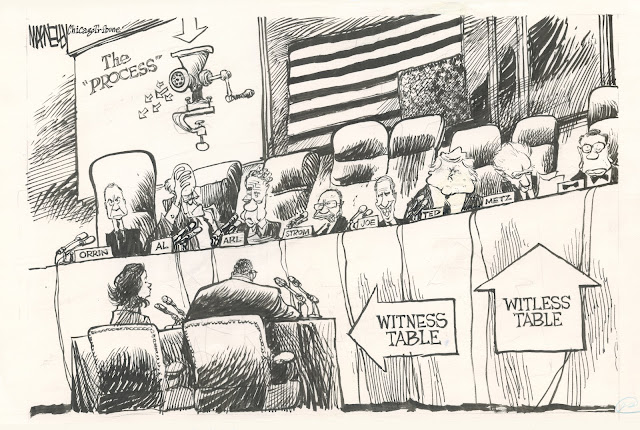
MacNelly pulls off the same trick with this next cartoon:  recognizable caricatures of eight different senators, sitting in chairs at eight distinctive angles, surrounded by a variety of embellishments.


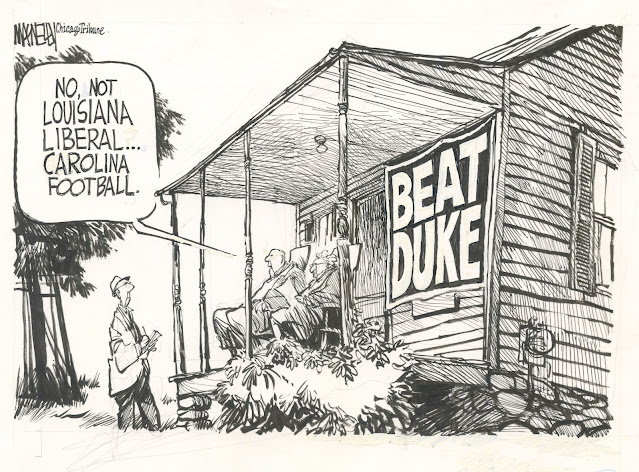
Even this third cartoon, which appears much simpler, is crafted with a watchmaker's precision.
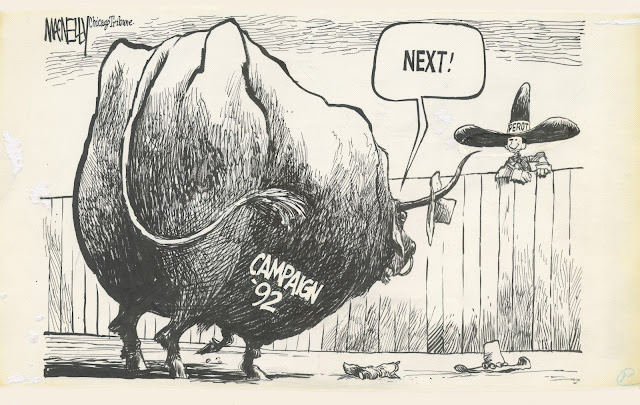
Note the beautifully constructed face of the threatening bull: with only a reverse 3/4 profile to work with (partially obscured by a drooping ear) MacNelly does wonders with that deadly eye, the curl of the lip showing uneven teeth, the hair on the chin and the ring in the nose.   Who can draw like this today?


The figure of Perot is tiny in the background, yet his ultra-simplified likeness is convincing, and details such as the rodeo gloves and the big hat are remarkably effective for their size.


Many artists who are able to exert this kind of control let the control dominate the picture.  Not MacNelly;  his drawings were always jaunty and friendly and informal.  How did he do it?

For one thing, look at how he darkened that bull.  It's one wild scribble:


Even when he's drawing something like the shade on the side of a flat wall...


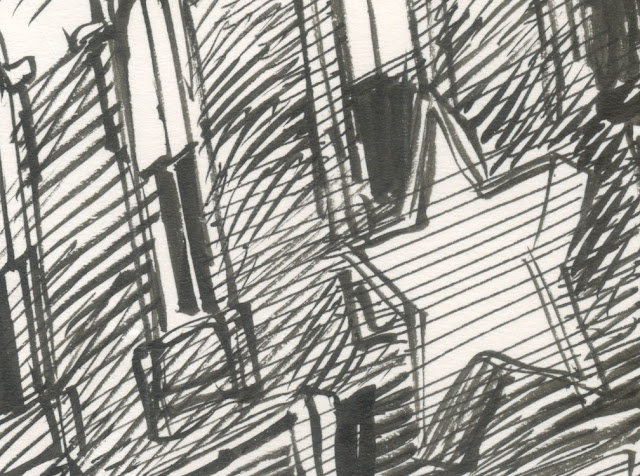
... he doesn't use consistent lines. No gray screen, zipatone or even cross-hatching here.  


These disorderly, unsystematic lines infuse his drawing with life. Compare MacNelly's loose approach with the work of other masters of "control," such as Franklin Booth, Virgil Finlay or Reed Crandall.  Compare it with the antiseptic technical drawing of Chris Ware and his legions of followers. 

Here's another drawing with a level of detail that might prove deadly in the hands of a less certain artist:

MacNelly pulls the same trick shading that wall:
But he has other tricks too.  If you're going to draw 16 distinctive people in a line, with their heads cocked at different angles and wearing different hats, you don't want them to serve as an anchor weighing down your drawing, you want them to contribute energy.  I love the way MacNelly smears this crowd together with line, and draws them hugging the curvature of the earth.
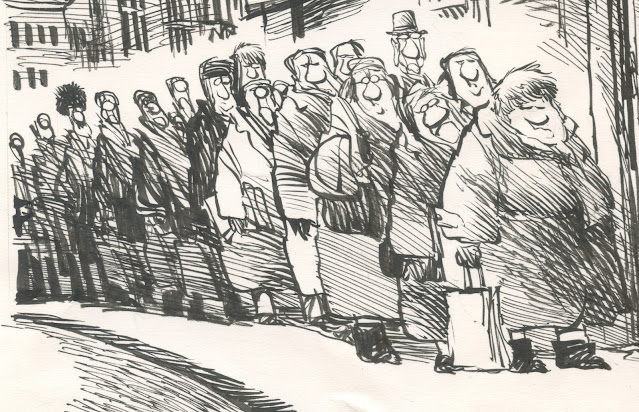
It's hard to think of a more dynamic way of drawing a crowd of patient people waiting in a long line.

Today's shrinking newspaper industry offers so few platforms for artistic talent.  Heaven knows what MacNelly would be doing as an editorial cartoonist in today's market.  But looking over our shoulder at his dazzling drawings, we get a renewed sense for what good drawing once contributed to journalism, and might contribute again. 


Monday, September 18, 2023

THOUSANDS AND THOUSANDS OF FACES

This drawing by Romanian artist Dan Perjovschi is about an inch tall:


It's one in a long line of faces like these...


...which are part of an even larger grid...


... which continues on and on...


...and on and on!


I really like these obsessive, energetic little faces.  I stumbled across them in the Taubman Museum of Art in Roanoke Virginia.   Each tiny face is more important and less important than you'd suspect.

The individual faces are more important because each is different, and worthy of a look-- no Photoshop or AI here.   Mr. Perjovschi doesn't coast on autopilot-- he paid for each of those faces.  His variety was stunning, and his sustained intensity was a little freaky.    


 But at the same time, each individual face is less important than you'd think.   The tiny faces blur together to create a single design effect. 


After thousands and thousands of these obsessive faces, they tend to disintegrate into more abstract shapes-- lines gone crazy in a way slightly (but not totally) different from the craziness of the faces they echo.


I take my hat off to Mr. Perjovschi for the intensity of his vision, for the level of clean, honest work that he puts into it, and to the art museum in the small town of Roanoke, Virginia, for introducing me to his drawings.


Tuesday, September 12, 2023

ARTISTS IN LOVE, part 22

 Another in a series about the strange doings at the intersection of art and love.


Jimmy Swinnerton

Jimmy Swinnerton's life was even zanier than the comic strips he created (including Sam and his Laugh, Professor Nix, Little Katy and her Uncle, Mount Ararat, Mr. Batch, Mr. Jack, Little Jimmy, Canyon Kiddies, The Daydreams of Danny Dawes, and Rocky Mason, Government Marshall.)  


Born in 1875, Swinnerton ran away from home at age 14 to join a traveling minstrel show.  He used blackface makeup as a disguise to elude his parents and the sheriff. 


Swinnerton led an adventurous life during the waning days of the wild west.  He rambled from job to job (and from bar fight to bar fight).  He drank heavily, gambled constantly, spent recklessly, and lied shamelessly.  These attributes made him irresistible to women.  


Depending on how we count, Swinnerton had somewhere between four and six wives. His biographer claimed that Swinnerton also “had a lady friend hiding behind every sagebrush on the desert," but let's confine ourselves to his wives.  Here's the scorecard:


  • Swinnerton's first wife was Thalia Treadwell, a glamorous San Francisco heiress. They married under mysterious circumstances; when friends asked for details, Swinnerton would only say, “the marriage took place between [San Francisco and New York] but I can’t tell you the place nor date for legal reasons.”  The couple quarreled bitterly, and Thalia abandoned her new husband and went to Japan. 
  • Swinnerton next married Harriet Hacker after a whirlwind courtship. Harriet was beautiful but she “enjoyed the night scene“ a little too much, going out to the clubs and sometimes not returning for days. When Swinnerton contracted tuberculosis he asked Harriet to move to the desert for his health, but she refused, citing the shortage of nightclubs in the desert.
  • Although still legally married to Harriet, Swinnerton moved to the desert alone.  There he quickly found a new girlfriend, Espie Castle.   The 1910 US census reports that Jimmy married Espie (which would've made him a bigamist) but in response to questions, he was evasive about their status. When Espie had a religious conversion and asked Swinnerton to join her in pious living, he quickly left. 
  • In 1917 Swinnerton belatedly divorced Harriet and two days later married his third – or fourth – wife, Louise Scher, a statuesque blonde divorcee.  The two quarreled constantly over Louise's spending habits on lace nightgowns.  Swinnerton borrowed thousands of dollars from her mother to pay for Louise's extravagances, then left without repaying her.
  • By 1933, Swinnerton was living in Las Vegas.  He divorced Louise and quickly married his fourth – – or fifth – – wife, Gretchen Richardson.  On her way to the wedding, Gretchen stopped off at a Vegas casino to play roulette. She placed a silver dollar on number 12 and when the number hit, she decided it was an omen and stayed to gamble rather than go to her wedding. She eventually showed up several hours late. 

Espie

Gretchen

Louise

The final Mrs. Swinnerton


Swinnerton was quick to marry and just as quick to leave.  He seemed to lack the patience or interest to explore what lay beneath the surface of his wives.  Yet, his attitude toward art was the exact opposite.


Swinnerton had infinite patience for painting the same desert landscapes over and over for decades.  He would loyally return every year to the same sites to paint the same scenes.  One of his exasperated wives complained, “why I do this each year I have never been able to figure out, because it’s the same trip, same road, auto camps, same climate, and has been for the last several years."  


Even Swinnerton's grandfather urged him to stop wasting his time on the same flat, drab "hellholes" such as Death Valley and the Mojave Desert and paint more glamorous landscapes.  Swinnerton responded that beauty lay beneath the surface, and that patience and faithfulness would be rewarded:  "Just you put full confidence in the [beauties of the desert] and she’ll show you all her secrets."  He would spend all day in the hot sun, carefully waiting for the desert to reveal her charms.


One has to wonder how Swinnerton's love life would've
changed if he'd devoted the same level of effort to his wife


Clearly Swinnerton didn't require the same variety in his landscapes that he required from his wives.  He found a sustaining variety in the rocks and sand (“Every minute in the desert is all new and completely different.")

It's also noteworthy that Swinnerton lied incessantly to his wives, yet as a painter he was obsessed with accuracy.  His mission was to make a true, literal representation of reality.

For some reason, Swinnerton's values in art didn't seem to carry over to his love life.  If painting gave him any insights into patience and the nature of beauty, those insights didn't seem to apply to his wives.  It's true that every artist must make tradeoffs, but looking at the meager quality of Swinnerton's paintings, one has to wonder whether he struck the best trades.


Saturday, August 26, 2023

NORMAN ROCKWELL, THE THUNDERBOLT OF KARMA

    Critics have studied Norman Rockwell's work from many perspectives, but no one has analyzed Rockwell's role as a vehicle for vengeful gods dispensing karma. 
    Behold the gods at work:

    • In 1994, a wealthy couple bought a painting by Norman Rockwell.  The couple spent a fortune because they admired Rockwell's talent and bonded with the painting which had "all the humor and artistic quality that Rockwell created in... his works.”  Decades later, the couple discovered the painting was not by Rockwell but by illustrator Harold Anderson.  Suddenly the painting's qualities disappeared in their eyes.  The humiliated couple filed a lawsuit blaming the seller for not recognizing that the painting was an “open and obvious” forgery.


    • In the 1950s Norman Rockwell's boss, the art director of The Saturday Evening Post, pressured Rockwell to give him several original paintings as a "gift" for the art director's personal collection.  When Rockwell mustered the courage to ask for his paintings back, he received no reply. Other artists working for The Post complained that they were similarly pressured to "donate" their originals in order to stay on the art director's good side when he handed out new assignments. In this way, the art director amassed an art collection worth millions.   He left that collection to his sons, thinking it would put them on easy street.  

    However, the inheritance turned out to be a curse. The sons bitterly squabbled over the paintings for the next 30 years.  One was accused of manipulating his father to screw his brothers out of the art.  Other brothers filed lawsuits claiming the father was mentally incompetent.  The brothers accused each other of theft, misconduct, civil violations, liability for damages, etc. They sued each other again and again.  By the time they had exhausted themselves and settled their feud, their lives were mostly over and their family was in tatters.


    • In 1943, Rockwell created four pictures about people waiting to see President Franklin Delano Roosevelt.  Rockwell admired Roosevelt and gave the pictures to Roosevelt's press secretary.  For many years they hung on the walls of the White House to entertain the public.  Then in 2017, descendants of Roosevelt's press secretary learned of the pictures and claimed they properly belonged to the family.  Family members began fighting amongst themselves over who owned the pictures and who had authority to donate them to the White House.  The newspapers noted that in the years of lawsuits that followed, the family tore itself apart over the art. 

    Rockwell was a thin, soft spoken man who lived for his art.  He wasn't always good at defending his own interests.  A casual observer might be forgiven for concluding that Rockwell was exploited by aggressive profiteers who saw an opportunity to feed on his talent and sacrifices. 

    Rockwell may have missed out on some of the money but ask yourself: which side ended up better off?  Which side offered a more meaningful existence?  

    It seems the wrathful gods occasionally place artistic talent on earth as glittering bait to lure and trap the unworthy-- those who, lacking talent to make art, see only opportunities to exploit or profit from those who can.