Saturday, February 25, 2012

THE CARTOONIST'S REVENGE

Everyone knows what it takes to have a successful career.  A college education is essential.  A graduate degree is even better (preferably in a field such as technology, business or finance).   You have to dress for success, build a network of important contacts, and cultivate the  Seven Habits of Highly Effective People.  Language proficiency in Chinese wouldn't hurt.

But on the other hand, if you have none of these you might try sitting alone in a ratty T shirt and drawing doodles.  When you lack the necessary credentials, or even basic literacy, a simple line can still be The Great Equalizer.


Cartoonist Thomas Nast could scarcely read or write but he had a greater impact than all the lawyers, accountants,  famous writers and powerful government officials combined in bringing down the corrupt politicians who controlled New York.  Nast's drawings resonated with the public and knocked the Tweed politicians off their throne.  He also created many popular symbols, such as the Republican elephant and Democratic donkey, and influenced presidential elections.  (Nast's wife Sarah corrected the spelling in his captions).  Nast became so wealthy from his drawings that he was able to hire scholars to read to him from Shakespeare, Dickens, and Twain as he worked. 

David Low: the Nazis shovel more troops into Stalingrad

David Low was born in a small remote town in New Zealand.  He had little money, no contacts and left school at a young age.  Yet, the lines he drew had an impact on international relations.  Hitler was enraged by Low's biting drawings, and the Nazi government formally protested to the British government.  After the war, Winston Churchill protested that Low's cartoons about a politically sensitive situation should be censored for the sake of "western democracy." 

Albert Dorne, from the Famous Artists School materials

Albert Dorne never made it past 7th grade.  A sickly child, born in the most brutal poverty and squalor, he leveraged a knack for drawing into great wealth, prestige and influence.  Dorne went on to fill many roles, as the head of a multinational corporation, a lecturer, author and instructor.  He consorted with movie stars and senators.  But each step of the way it was his drawing that made everything possible.

The great Jeff MacNelly captures President Carter's dilemma

Jeff MacNelly dropped out of college but his brilliant drawings gave him influence with a huge audience that was the envy of career politicians and policy experts. When he won his first Pulitzer prize at age 25, MacNelly said he was hanging the certificate high on his wall to fool visitors into thinking it was a college degree.


In the last few years there have been several incidents where drawings of the prophet Muhammad have upset the balance of international relations, inspiring wild mobs to riot, kill, invade and burn down embassies.

 Cartoonists may not be paid the way investment bankers are paid.  They don't get preferential treatment in fancy restaurants the way movie stars do, or command armies the way political leaders do.  They mostly dress like slobs.   But in their ability to make a line on paper, they still have the means to shake up the world.

Tuesday, February 14, 2012

Saturday, January 28, 2012

ONE LOVELY DRAWING, part 39

Howard Pyle illustrated more than 125 books. 

Of those books, he wrote 24 himself. 

Of those 24 books, one-- Pepper and Salt-- contained 90 of his illustrations.

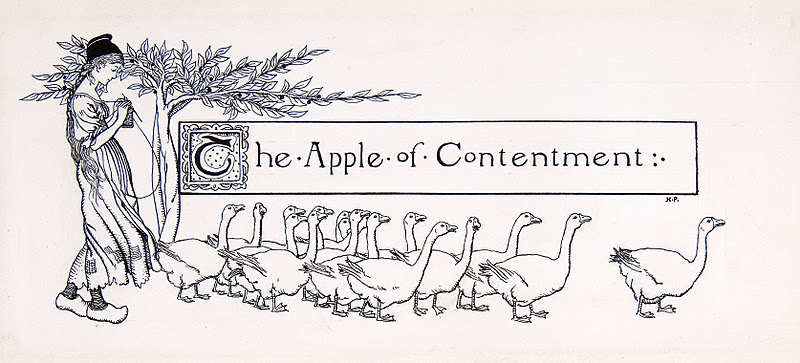
Of those 90 illustrations, one was this small pen and ink headpiece of a girl with 17 geese:

Many thanks to Molly and Mary at the Delaware Art Museum for locating this drawing that I recalled seeing there 20 years ago.

The first thing you notice about these 17 geese is that Pyle treated each one differently, with its own angle or stance or personality.  Each has its own dignity: 


There are no stray lines to suggest geese in the background that Pyle didn't feel like drawing completely.  No Photoshop.  No photocopiers.

Charles Dickens wrote:
I should never have made my success in life if I had been shy of taking pains, or if I had not bestowed upon the least thing I have ever undertaken exactly the same attention and care that I have bestowed upon the greatest.

Tuesday, January 24, 2012

BEFORE BOB PEAK WENT HOLLYWOOD

Illustrator Bob Peak was probably best known for his movie posters.  As far as I am concerned, that's unfortunate. 

James Bond: The Spy Who Loved Me

Peak has been described as "The Father of the Modern Hollywood Movie Poster."  He created over 100 movie posters, including significant posters for blockbusters such as Apocalypse Now, Superman and the Star Trek movies.

Star Trek
Personally I find much of his movie work artistically disappointing.  Opinions will differ of course, but to me these posters often seemed formulaic and uninspired.  Worst of all, Peak-- or his Hollywood clients-- became enamored with a "diamond diffraction" gimmick which I find totally cheesy.


I thought about this recently when I visited the archives of the legendary Famous Artists School and came upon a lovely, neglected collection of drawings that Peak used for teaching in the early years, before he went Hollywood.  I think these simple drawings have more enduring value than Peak's movie posters:


These drawings have originality and sensitivity, but most of all they have a truthfulness about them.  Such qualities give humble drawings a strength and stateliness that outweigh all the budget and muscle of a Hollywood extravaganza.


Man, that's drawing!


These drawings have not had the same worldwide audience as the movie posters-- for the most part, they have only benefitted art students who pass through the Famous Artists School training-- but as far as I am concerned they are more inspirational and instructive than the movie posters for which Peak is so well known. 

Saturday, January 14, 2012

HOWARD PYLE'S WEEKLY DRAWING SESSIONS

All images courtesy of the Delaware Art Museum

Howard Pyle, the father of modern illustration and one of America's most important painters, died just over a century ago.  To commemorate the anniversary of his death, the Delaware Art Museum mounted a splendid centennial exhibition reminding us of Pyle's contribution.  (You can find information on the show here and here.)

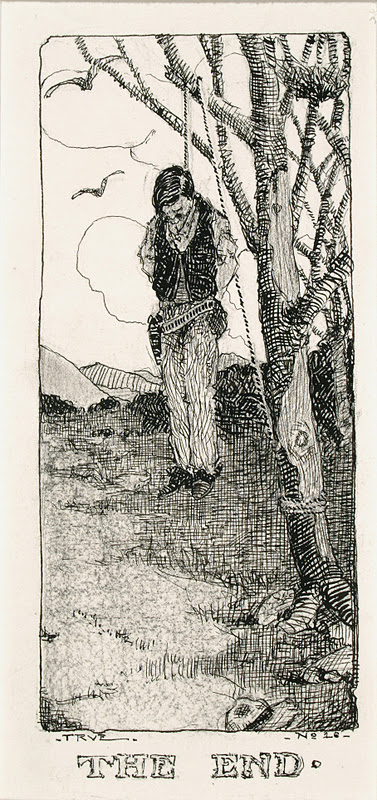
Eight years before he died, Pyle asked his art students to sketch their own concept of "The End."  The Delaware show includes a selection of those drawings:
In 1903, Howard Pyle and his students gathered for weekly drawing sessions, in which Pyle assigned a subject for everyone to sketch. On the evening of March 25, 1903... sixteen members of the class created sketches of "The End."
Sitting around that room was a charmed circle of young talent.  Pyle had received nearly 100 applications for every opening in his school that year.  Students such as N.C. Wyeth,  Frank Schoonover, Stanley Arthurs, William Aylward, and Harry Everett Townsend were at the beginning of what would turn out to be brilliant careers.  But on that day in 1903 they had no idea of what lay in store for them, or what  their own "End" might be.

Death would catch up with Pyle unexpectedly during a trip to Italy with his family.  Who would have guessed that this most American of artists was destined to be buried in a foreign land?

It is hardly surprising that the future nautical painter W.J. Aylward chose a sinking ship for his theme.
 

Fifteen years later, Aylward would find himself on a ship steaming toward World War I as an artist for the Armed Expeditionary Forces (along with his fellow student Townsend).  Passing through the enemy submarine zones with their constant alarms, Aylward had plenty of time to meditate on his choice of an end.

N.C. Wyeth's idea was to draw a man who succumbed to the cold:


Wyeth had a fertile imagination but even he could never have predicted that 42 years later, after a long and fruitful career, he would meet his own fate in a car stalled on the railroad tracks, with his helpless  grandchild trapped by his side.

Another student in that room, Frank Schoonover, outlasted all his comrades.  He met his end peacefully in the 1970s at the age of 95.  He lived long enough to see the empire of modern illustration that arose from such humble origins, and to lecture to the public about those early days at the Pyle school. 

Henry Jarvis Peck envisioned a prisoner's end:

Allen Tupper True, with his preference for western art, envisioned a cowboy hanging from a tree:


Samuel Palmer took a more whimsical approach, apparently viewing the End as the end of a circus performance:


Pyle's huge influence was due in part to the fact that his imagination and talent were perfectly suited for his moment in history.  Pyle worked in an era of change, when technology transformed the quality of mass reproduced pictures, and economics transformed the methods of delivering those pictures to the public.  His career began when a small handful of black and white journals such as Century and Scribners contained primitive wood engravings, and ended as dozens and dozens of color magazines were beginning to blossom with innovative illustrations and graphic design. 

Just as Gutenberg's invention of the printing press in 1440 led to the democratization of knowledge, these changes in the 19th century led to the democratization of art.

Pyle had the vision to hitch his great talent to the technological and economic changes of his day, but the Delaware museum show makes clear that the crucial ingredient for his success remained heart, rather than technology or economics.  In his excellent chapter in the Catalog accompanying the Delaware show, painter James Gurney quotes Pyle's students:
Thornton Oakley recalled "During three years with him he did not mention a word about materials, methods, mediums or techniques." Too much emphasis on technique, Pyle warned, would result in a kind of mannered overindulgence, where the means become more important than the message.
Instead, Gurney writes, for Pyle "the expression of an emotion or an idea was paramount."  Rather than instructing his students on the technical applications of the new photoengraving processes, he assigned them themes such as "Coming Home From the War" or "The End."  He told his students, "Project your mind into your subject until you actually live in it." He wanted them to be able to "smell the smoke" when painting a battle scene. "Throw your heart into the picture," he said, "and then jump in after it."

Then as now, improved delivery systems were not enough to change the world.  Pyle could never have been a major catalyst for the Cambrian explosion of modern illustration if his pictures had a less persuasive heart.

Saturday, December 31, 2011

PORTRAIT OF THE ARTIST IN TIMES OF CHANGE

You think you've got career problems? Russian artist Zinaida Serebriakova launched her career just as the world was starting to unravel.

Self-portrait as a young art student

Zinaida turned 21 during the Russian Revolution of 1905 when widespread violence, poverty and political upheaval did little to help the art market.  Even bigger revolutions were just around the corner.  In 1905, a young patent clerk named Albert Einstein published the theories that would overturn centuries of scientific beliefs and transform our understanding of space and time. 

 That same year, Sigmund Freud published his revolutionary book describing how our "logical" behavior was really governed by subliminal compulsions and irrational urges.  As if to confirm that the Age of Reason was truly dead, hostile nations were already spiraling toward World War I.

It was in this unpromising environment that Zinaida set out in search of beauty.

Zinaida brushing her hair in the mirror

During her lifetime search, Zinaida painted a remarkable series of self-portraits.

Newly married at age 22
Age 27, by candle light
Modeling a scarf
Age 30: a mother
In art as in politics, the old rules were coming apart like wet tissue paper.  Zinaida had been trained traditionally by the great Russian illustrator Repin but now artists such as Picasso and Matisse were pursuing what Hilton Kramer called "a netherworld of strange gods and violent emotions."  Soon the futurist painters would add their own fiery polemic:
What is the use of looking behind?... Time and Space died yesterday.... We want to glorify war — the only cure for the world — militarism, patriotism, the destructive gesture of the anarchists, the beautiful ideas which kill, and contempt for woman....We want to demolish museums and libraries, fight morality, feminism....
Despite all this, Zinaida steadfastly continued to pursue her own notion of beauty, lovingly painting the human body in a representational style.

During times of disintegration, revolutionaries, priests and utopian ideologues compete to fill the vacuum (usually causing widespread misery for the innocents caught in the crossfire).

Zinaida fell in love with a young engineering student but the church barred their marriage due to questions about the young man's faith. The couple got around the church's objections, married and had children shortly before politics intervened in the form of the February Revolution of 1917. Violence returned again that same year with the October Revolution, when Zinaida's lifelong home on the grounds of the Neskuchnoye estate was burned and its food supply plundered.  The new Bolshevik government rejected democracy in favor of a "dictatorship of the proletariat" and threw many people in jail, including Zinaida's husband.  There he contracted typhus.  He was released shortly before he died in 1919.

In the words of Leon Trotsky,
"You may not be interested in war, but war is interested in you."
Zinaida was left with no money, four hungry children and a sick mother.


She managed to feed her family by drawing pencil illustrations for the Kharkov Anthropological Museum.


Then in 1924 she learned of an art job in Paris. Zinaida left Russia temporarily only to find when her project was completed that hostile relations between the countries prevented her from returning to her family.  With the help of the red cross, the distraught mother was able to smuggle her two smallest children out of the country.  However, she remained separated from her two older children for over 30 years.

Zinaida felt relatively safe working in France until the Nazis invaded.  Then her  Russian citizenship was sure to get her arrested, so she became a French citizen.  All the while, she continued to draw and paint.
Age 54
Age 62
Age 71
Looking over this lifetime of self-portraits, I am struck by the persistence of Zinaida's smile, and the tenderness that seems to have outlasted the forces that buffeted her.

She resisted assignments painting Soviet generals and commissars and refused to become caught up in ideological painting of her day.  Instead, she turned again and again to the purity and tenderness of the naked human form.  Her daughter recalled:
The female nude was mother's favourite subject. While she was in Russia young peasant women would pose for her. In Paris her friends would come over to her studio, drink a cup of tea, then they would stay and pose for her. They were not the professional models that you might find in Montparnasse and maybe this is the reason why they are so natural and graceful.


Today on the cusp of 2012, we can already see the next crop of despots eager to impose their solutions.  They've had a century to refine Lenin's special math that justifies sacrificing individual human beings to achieve some glorious future for humankind.  By now, they have become positively glib at it.

But Zinaida's joyous pictures suggest that she viewed the math differently, from the side of the equation where the individual is everything.  Pink cheeks here and now outweighed any blueprint for a distant utopia. Her math seems to have helped her remain indomitable during the years when artists with a more intellectual approach reacted with cynicism and despair. If you ever meet a person with such an attitude, marry them quick.  It will be the best thing you can do for the quality of your day-to-day life.

I wish all of you a happy, healthy 2012.

Tuesday, December 13, 2011

ART BASEL MIAMI BEACH

It's too early in the season for the star of Bethlehem, so that glow in the sky last week could only have been the neon lights from "the most prestigious art show in the Americas," Art Basel Miami Beach:
photo by Casey Kelbaugh, New York Times

The Miami show, we are told,  brought together 250 "leading galleries" from around the world, "including the world's most respected art dealers offering exceptional pieces by both renowned artists and cutting-edge newcomers."

Photo by Casey Kelbaugh, New York Times

Don't bother looking for any crass illustration art at Art Basel Miami, Jocko.  This was 100% fine art, in all its finery.  The New York Times described it as "a holy gathering on the annual pilgrimage route of the super rich."  The number of private jets arriving at the local airport rivaled those of the Super Bowl, and a "line of quarter million dollar cars [was] idling while their owners waited for a parking valet."

You cannot attract such an audience of billionaires, socialites, celebrities and arrivistes with mere commercial art.  They would recoil at the notion of art commissioned for functional purposes.  Instead, such buyers must be flattered into believing they are purchasing something spiritual which demonstrates their sensitivity and perceptivity.

For example, in the panel convened to discuss The Future of Artistic Practice, the moderator began with a common theme:
Poetry is always what can't be sold....It has no usefulness.  It is merely useful through the ethical and aesthetic awareness that results from it. Poetry.... holds out in a world where people tend to lose all their spiritual values in favor of practical, predatory goals.  
This year more than 50,000 seekers of spiritual values clogged the bars and spas of Miami, buying at lavish prices.

And these weren't just your traditional tired old billionaires and hedge fund managers.  A whole new generation of the artistically sensitive has emerged:  Paris Hilton, of the Hilton hotel dynasty; Dasha Zhukova (daughter of a Russian oil mogul and accused international arms smuggler, wife of a multi-billionaire alleged to have made his first fortune as a ruthless Russian gangster);  Vito Schnabel (son of famous blowhard Julian Schnabel); Diana Picasso (great granddaughter of Pablo); even the tasteful Donald Trump dynasty was represented.  This new generation of talent is what comes of outlawing the guillotine.

Noted performance artist Ryan ("I'm an artist so I'm not, like, an asshole") McNamara took the microphone to speak about the artistic challenge of staging "subversive" performance art at the parties of such wealthy people:  "Halfway through the party I had these revolutionaries come in, run through the crowd screaming and then attack the cake with frosting... all they wanted to do was make the cake more delicious."

Also present was famed British artist Tracey Emin.

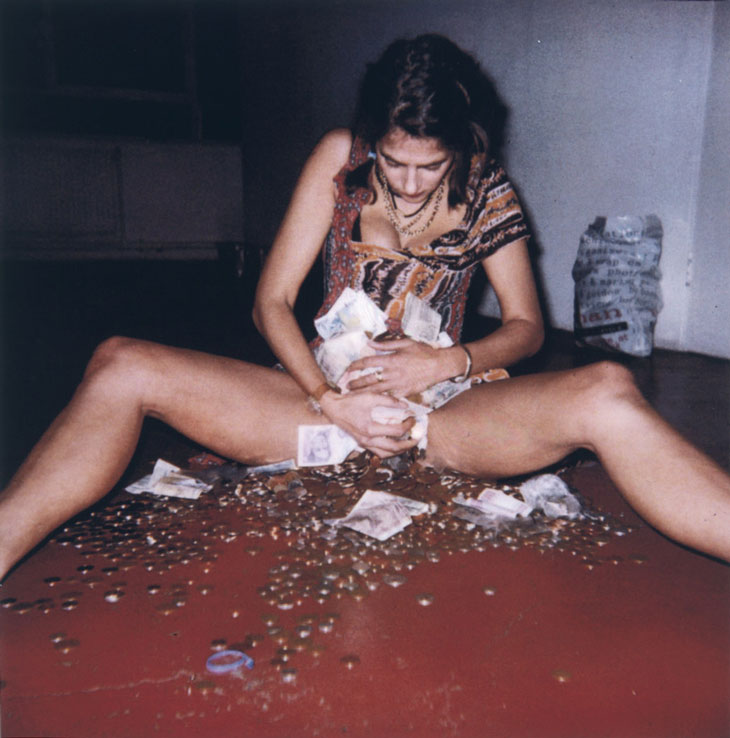
Art by Tracey Emin

The Saatchi Gallery describes this work of art as "a transient crowning glory," continuing (for the benefit of those who may have trouble recognizing glory): "Emin's triumphed over all and has money up the whazoo to boot." Emin was at Basel to share her technique: "I like to lie in bed in the morning for an hour just thinking, thinking thoughts.  And that's one of my favorite things to do."

Artwork produced using Tracy Emin's patented technique of "thinking thoughts"

Other great thinkers joined in to advance the path of culture.   For example, Jonas Mekas took the stage to read his poem which sheds light on the nature of beauty:
Their beauty
Was beautiful....
It was so totally somewhere else
And so far from what's on TV....
 If there was ever a time when illustration was more "commercial" than fine art, that time is long gone.  Today's gallery art is far more commercial.  But even worse, the quality and seriousness of fine art has been eroded by the current emetic marketing model.