Saturday, October 26, 2024

THE ONLY TIME YOU'VE GOT


" I don't know whether this is the best of times or the worst of times, but I assure you it's the only time you've got."    
                                                --  Art Buchwald

I recently attended a talk at the Society of Illustrators where the speaker declared that the 1960s were "the golden age of illustration." 

But in the 1960s, illustrators believed the golden age was already over.  The Society's Annual asked, "Is illustration over the hill?...  I don't think illustration will ever regain the popularity it once had."  Illustration historian Walt Reed explained why the 60s were actually wretched for illustration: "Television had stolen the fiction magazines audience and illustration's former position as a pace setter for popular culture was usurped....Illustration's role became more incidental and decorative."

It seems that every generation of illustrators is convinced they missed out on the good times.

Back in 1927 a prominent art critic insisted that the golden age of illustration occurred in the late 19th century, and that the field went downhill at the start of the 20th century.  In his essay on the decline of illustration, he asserted: 

 [Illustration] soon departed from the decent standards of the old school, and so debased drawing into the cheapest form of mechanical ingenuity —slippery, sentimental stuff.... As connecting links between the old and the new orders, I may mention Charles Dana Gibson and Howard Pyle. 

Gibson, he complained, "was limited and mediocre, and despite the most valiant efforts was unable to learn the first principles of draftsmanship."  Pyle, he claimed, was a "prolific hack."   He mourned that by 1915 the field of illustration was disintegrating because "the leading American magazines have discarded illustration."  

In the following generation, another great historian-- Henry Pitz-- had a different view of the golden age.  He claimed that the era of Gibson and Pyle had been the true golden age.  He insisted that it was the next generation of illustrators in the 30s and 40s who had gone astray; they became obsessed with mere design.  For these callow youngsters, "momentary impact was to be of more importance than leisurely scrutiny of content.  Character delineation slips away from us-- no one over 21 has much right to appear on a double spread."  

Yet, later generations would look back on the 30s and 40s as "the glamour years."  By the 1950s, according to the Society of Illustrators Annual, "the glamour years of illustration had passed.  The reading public was diminishing....The role of the illustrator as a means of enticing readership was dwindling." Gone were the big budgets and generous deadlines for illustrations painted in oil on big canvases.  Gone were the deluxe illustrated books and the magazines filled with costumed adventure stories.  Illustrators were painting in smaller scale on illustration board using fast drying paints. 

Later generations saw things differently.  They would look back jealously on the bountiful 1950s, the era of The Famous Artists School, with talented artists such as Rockwell, Briggs, Dorne, Fawcett, Ludekens, Parker,  von Schmidt, Helck, Gannam, Sickles and others.   Al Dorne drove a custom Mercedes with a burled walnut dashboard and a pull-out bar. His steering wheel had Dorne's initials engraved on a silver plate below a star sapphire.  That sounded pretty good to later generations.

And so it went, on and on.  The good years were always yesterday.  The current market had always become terrible.  

Scholar Walt Reed described the dire condition of illustration in the 1990s:

Recycling already-published images inexpensively through huge image banks is changing the financial foundation of the field.... [Illustrators] are increasingly replaced by a novice with Photoshop....the bread-and-butter work is vanishing.

Artists tried to keep up with the changing times.  Pioneers of technology thought the future belonged to "internet art" but artists have already been warned that post-Internet art is the "new aesthetic era."

So what lies ahead?  This cycle of destruction and renewal over the past 125 years of illustration should make us cautious about predicting the end of illustration.  But can this history teach us anything about survival as illustration enters the brave new world of generative Artificial Intelligence?

John Cuneo

In the next few days I'd like to offer you some examples and pose some questions regarding whether this is really the end of the road for illustration as we know it.  But even before we start, the one thing we can be certain of is that Art Buchwald was right:

 "I assure you it's the only time you've got."


Monday, August 26, 2024

ONE LOVELY DRAWING, part 75

 Once upon a time, a single line drawing could dominate a full page of the New York Times.


They took a pen and ink drawing by the great Ronald Searle, enlarged it several times and cleared the decks.  The result was the most compelling page in the entire newspaper on March 1, 1970.  Probably the whole month of March.

What art director today has the courage to rely on a line drawing to fill such a role?  What illustrator today has the talent to fill such a role? 

Searle was such a pro-- look at the way he claims that real estate.  He confidently captures the height by stretching those legs, one flung high and one flung low.  All he needed was a single crude line.  He captures the width with a long cane on one side and flapping coattails on the other side.   He's in full command, and no one could dare push back against his use of that space. 

Fearless!


Sunday, August 18, 2024

LEARNING TO DRAW IN THE 4TH DIMENSION


Michelangelo wrote:

Drawing constitutes the fountainhead and substance of painting and sculpture and architecture... and is the root of all sciences.  Let him who has attained the possession of this be assured that he possesses a great treasure.

Is this still true?  

Lately, drawing seems beleaguered by new technologies that changed our artistic priorities, shortened our attention span, devalued our skills, and drowned us in billions of images all barking for our attention.  To view these images we now depend on search terms for the efficient extraction and curation of information; the days of Mussorgsky's leisurely stroll contemplating Pictures at an Exhibition are over. 

Even worse, artificial intelligence suggests that the future role of the artist may be to create prompts that will be embodied digitally.

Nevertheless, keep in mind that art has been adapting to technology for a long time.  100 years ago, when animation changed the job description of an artist, it's inspiring to see how human creativity responded.

For thousands of years, artists had been staging drawings to lead the eye around a stationary image.  Now they were working with the 4th dimension, time.  The artists at Disney needed to apply traditional qualities, such as balance, proportion and composition to the movement of  a camera instead.  

I love the following combination of drawing and engineering that mapped the movement of Pluto in Mickey's Kangaroo (1935).  It's a good example of Michelangelo's point that drawing is the root of all sciences."

"Drawing is thinking." -- Fred Ludekens

In the following example from Snow White, Disney artists move the camera from the evil queen walking away to a close up of the lock on the dungeon door behind her.

This is not the way a conventional pencil drawing would be staged for a magazine illustration,
but it's just as creative, and well suited for its new purpose.

In the following dramatic drawing, we see three different versions of the queen running down the staircase at three different stages, as the artist imagines the camera swirling around.


Disney's artists were terrific at drawing dungeons just as N.C. Wyeth or Howard Pyle might have, but  those painters would have staged the picture to lead the eye from one priority to the next.  The animators had to adapt their prison creatively to the challenges of the new technology.  

Note how the queen's hand casts a shadow against the wall as she descends the vertiginous staircase in the following example.  These animators really understood traditional drawing but applied it to a new purpose.  


There's no doubt that the role of creativity will need to continue to adapt to changing tefhnologies, but looking over our shoulder at how art has proven so resilient in the past, I can't help but feel a certain confidence and pride about our prospects.


Friday, August 09, 2024

LITTLE ORPHAN ANNIE AFTER 100 YEARS


This week marks the 100th anniversary of the start of the comic strip Little Orphan Annie-- a prodigious cultural achievement that lasted over 40 years.  Such milestones should not pass by unnoticed.

The creator, Harold Gray, was a combination of Charles Dickens, Raymond Chandler and Scheherazade. His gritty, spellbinding tales of life during the Depression and World War II kept a huge segment of the population transfixed; his characters inflamed the emotions of his readers as he led them through one winding story after another. 


Gray was a consummate storyteller

Gray's weird art was the perfect complement to his stories.  Viewed in a vacuum, his linework might seem crude but his drawings were exactly what the art form called for. His overworked cross hatching, distorted figures and heavy line would later serve as a precedent for popular artists such as R. Crumb, Art Spiegelman and Chester Brown, but in my view Gray was better than all of them.  

His political views sometimes bordered on loony, but that only contributed to the powerful noir feel of his strip, and the ominous tone that pervaded many of his stories.


More prescience from Gray, 80 years ago


Mr. Gray, I salute your accomplishment and your marvelous contribution to American culture.


Monday, August 05, 2024

ERUPTIONS OF COLORITO

Colorito is the term coined during the Renaissance to describe painting in which color dominates, and is used for sensual expressive purposes.  

The greatest example of colorito in Renaissance painting was Titian. 

Titian, Euopa and the Bull

Titian's innovation with color may have been the result of innate talent... or perhaps it was the fluke of where he lived.  

Titian happened to live in Venice when it was the center of pigment trade in Italy.  Venice was a port city in the Byzantine empire, a city of colors and spices, where commerce brought all the richest colors necessary for creating sumptuous effects.  Titian made full use of them. Not only that, but the reflected light from the city's rippling waterways created an effect on colors very different from the light in other places.  If Titian had been born 120 miles away in Florence, where rival painters championed Disegno (drawing or design) over colorito, his art would probably have developed very differently.  In Florence artists painted frescoes on plaster, but frescoes would not survive for long in the waterways of Venice.  Titian achieved his color effects with oil glazes.

Centuries later, Howard Pyle worked as an illustrator in the colorless world of 19th century illustration.  He labored over hundreds of black and white illustrations, often reproduced as wood engravings. But by the end of the 19th century, new technologies appeared on the horizon, holding out the promise of accurate full color reproduction.

Christine Podmaniczky, associate curator at the BrandywineMuseum wrote,  

in its earliest stages, four-color printing had several drawbacks.  The new process required special ink-receptive paper that could be printed on one side only.  it also required exact registration of the four plates.  Certain colors...were difficult to duplicate with...inks available at the time....Nevertheless, by 1903, Howard Pyle confidently instructed his students to develop their skills in color painting because cost-effective and accurate color reproduction would soon dominate the printing industry.

Pyle had the vision to recognize the opportunities of that time in history.  Like a prisoner released from a long internment, he began painting pictures that exploded with color unprecedented in published illustrations.

Pyle, the Buccaneer, 1905


Pyle,  Attack on a Galleon


In the 1950s, graphic designer Bob Peak looked like he was on a path to an unremarkable career as a bland commercial artist.

Then scientists developed a new set of brilliant colors, which dropped a whole new toolbox in his lap.  Simultaneously, 1960s social changes created a huge new market for pictures with intense, bold colors.  


The whole world of popular media became brighter and more intense.  In a culture dominated by disegno Peak would not have flourished, but by being in the right place at the right time, Peak ended up at the center of another volcanic eruption of colorito.


Thursday, July 25, 2024

LIFE DRAWINGS, part 5

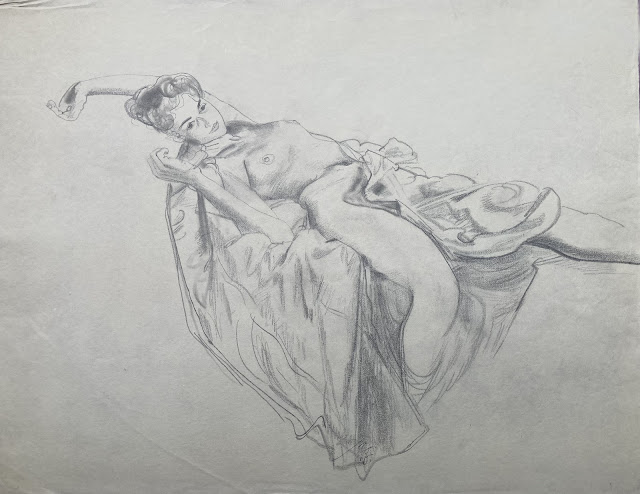
In recent weeks, we've looked at different approaches to figure drawing, and discussed how different artists can use the same human form as a vehicle for wrestling with very different types of issues of both form and content.

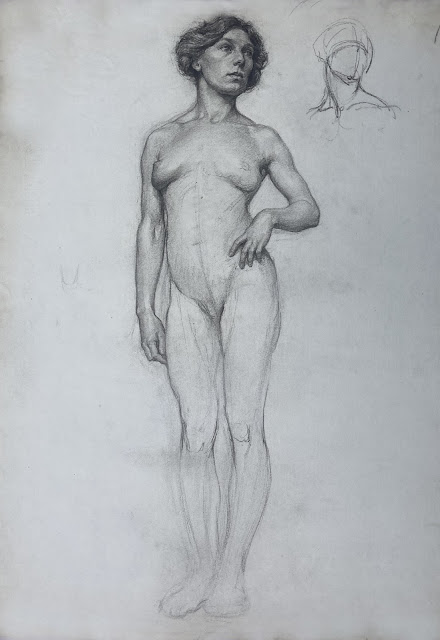
In earlier days when illustrators were classically trained in anatomy, figure drawing seems to have been a far more literal educational process.  Here are some figure studies by illustrator E. F. Ward who was in George Bridgman's anatomy class (along with Norman Rockwell.)


The class sometimes drew figures in costume:


There has been a great deal of talk about artists revealing subliminal truth and the narrative fallacy in theor life drawing, but fromwhat I've read, Bridgman would have no patience or sympathy for such theories.  He expected that the purpose of these studies was to learn anatomy.


Friday, July 19, 2024

LIFE DRAWINGS, part 4

 I've previously written about the great Australian illustrator and war artist, Ivor Hele.

A veteran of many bloody battles, Hele's figure studies frequently turned out to be "death" drawings rather than life drawings.  

However, when he returned home to his wife Jean,  Hele drew her in all sorts of domestic situations (some are NSFW):

Putting on her stockings in the morning:


Reading a book:


Reading a book wearing nothing but shoes and socks:


Sleeping:


Hele was unambiguous about his interests:


But those interests never eroded his high standards or stopped him from excellent figure drawiung.


Saturday, July 13, 2024

LIFE DRAWINGS, part 3

 Not every artist can afford to hire professional models to pose on a model stand in a spacious studio. 

Living in a small apartment, sharing space with relatives (particularly during years of war rationing) artists may still feel the same burning need to record life, and still respond to that need with insightful, excellent drawings. 

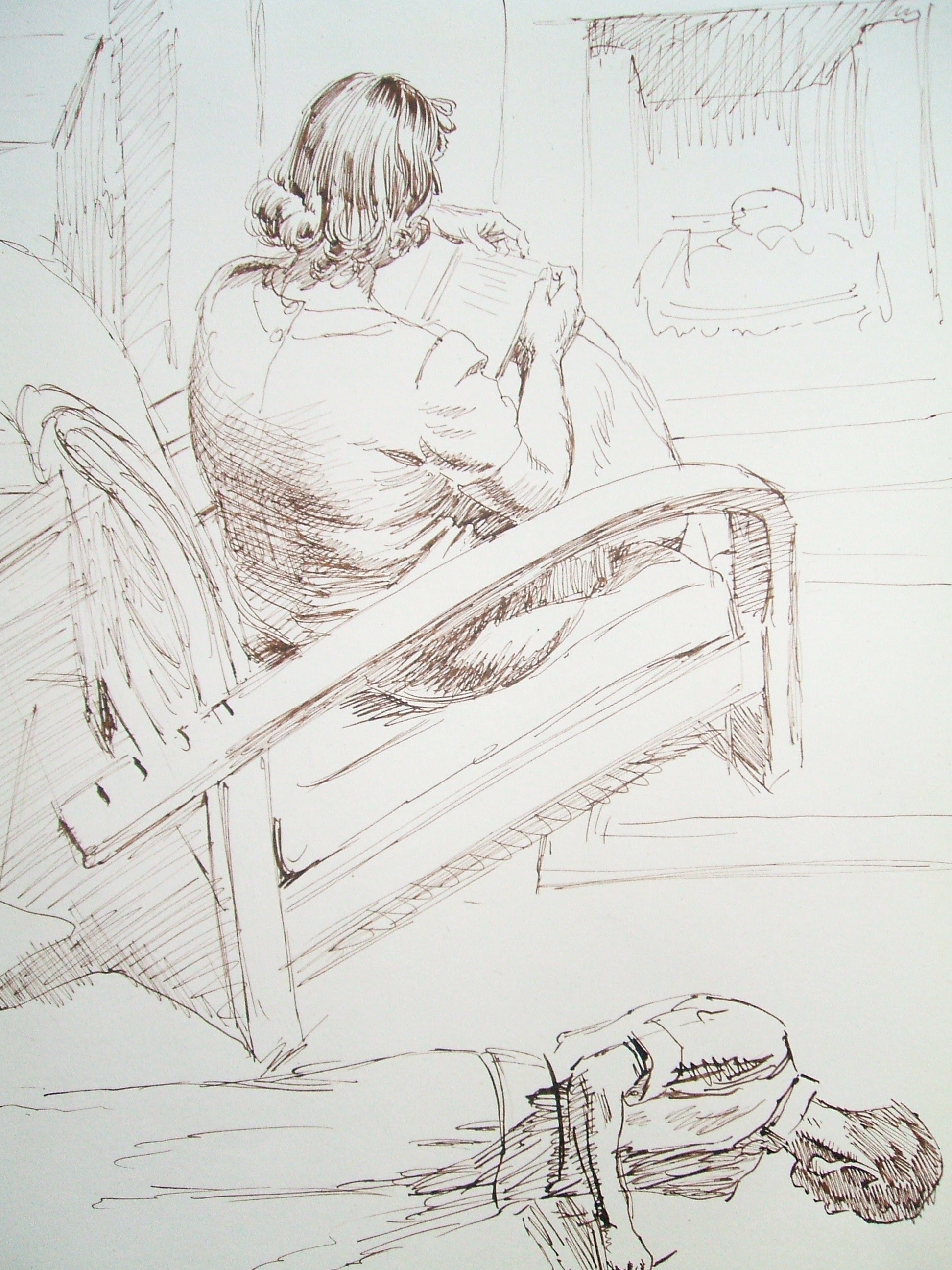
I admire the work of English illustrator Raymond Sheppard (1913-1958) who justly earned fame for his illustrations of animals.  He did much of his professional work at the zoo, but when the zoo was closed Sheppard drew his family at home, reading, knitting, napping or even posing.


Sheppard used these life drawings to create genuine challenges for himself.  Note how he draws these family members from difficult angles, testing his powers of observation. 


Unlike professional models, children don't always sit still, so Sheppard had to be prepared to capture his subject quickly:


Sheppard paid a high price for these drawings; he was diagnosed with cancer at age 33 and spent much of his remaining years in pain.  Yet, rather than languish he found it meaningful to devote the rest of his life to making careful, patient drawings such as these life drawings.

Sheppard's self portrait


Tuesday, July 09, 2024

LIFE DRAWING, part 2

At the height of his career, illustrator Robert Fawcett continued to practice drawing from the model every week.  


He'd have a model come to his studio and at the end of every session he'd lift the lid on the model platform and toss in his drawings for the day.  When he died, there were hundreds and hundreds of life drawings which his widow handed out to his friends and admirers. 

This is a life drawing from Fawcett's days as a teenage student at the Slade School in London, complete with comments from his instructor.  

Here is a sampling of drawings from Fawcett's model platform:


Detail
Detail


Fawcett's familiarity with the human form helped him block out figures in preliminary layouts for illustrations:


While a student at the Slade School, Fawcett used to complain bitterly about their incessant focus on drawing from the model. Thirty years later, at the top of his profession, he saw new value in the process.

___________________________________
Post script: Fawcett had disdain for artists who spent their time "noodling and polishing simple figure studies."  He said that such studies "might now be blinding in their degree of finish, dazzling in their virtuosity, but we ourselves would be neatly trapped in that comfortable corner from which so many students fail to find the exit."  The following two studies (one version in charcoal, the other in ink) were done for propaedeutic purposes but the third study, more purposeful and strong, seemed closer to Fawcett's natural preferences.