Monday, February 19, 2024

A HUNDRED ARTISTS ON THEIR BACKS


When I first saw the ceilings of the Uffizi Gallery in Florence, I was gobsmacked by their ornamentation -- nearly a hundred galleries dense with weird figures, mysterious symbols, grotesque creatures, bizarre landscapes and mythological tableaus, stretching as far as the eye could see.  (Virtual tour courtesy of Google Maps available here ).   


The ceilings on the Uffizi corridors were painted by teams of artists starting in 1579 and took hundreds of years to complete. But the ornate style originated in the ancient palace of the Roman emperor Nero, the inspiration of fresco painter Famulus.  With the passage of time, Nero's palace was buried under rubble and forgotten but it was accidentally rediscovered at the end of the 15th century when a boy fell through a hole in the ground and landed in a strange grotto surrounded by eerie painted figures. 

The rediscovered paintings became a sensation.  The greatest Renaissance artists, including Raphael and Michelangelo, were lowered down shafts to study them.   Around this time, the Medici family began constructing the Uffizi and decided to decorate the ceilings of the corridors in this latest fashion.  

During my first visit to the Uffizi it was impossible to linger over details or even take take a decent photo because other visitors, similarly gawking at the ceilings, kept bumping into me. But now I'm pleased to report that the nearly 100 ceiling galleries have been carefully photographed and catalogued in a book, Le Grottesche degli Uffizi by Valentina Conticelli.


The book enables us to see the details of these frescoes for the first time, and they confirm what we always knew: that you can't put that many artists together for that long without generating all kinds of mischief.

In the next detail, some long ago scamp subtly beheaded the figure on the left:


We also get a better look at the thousands of tiny, imaginative creations invented by hundreds of artists lying on their backs.


More than one artist turned their portion of the ceiling into an open air trellis.


Just as the frescoes on the ceiling of Nero's palace were buried out of sight for centuries, the frescoes on the ceiling of the Uffizi were hidden in plain sight for centuries, obscured by their height and by their overwhelming volume.  Valentina Conticelli's book corrects that, and puts these images at your disposal.

Monday, January 22, 2024

THE QUESTION IS PERMANENT; ANSWERS ARE TEMPORARY

 In my recent post admiring a painting of a tree, someone commented that artists have been drawing trees for 30,000 years, and suggested that there could not be much new to say.  But as William Irwin said, "the question is permanent; answers are temporary."

Trees may not have changed much in 30,000 years but nevertheless here are some innovative pictures of trees that I think are absolutely marvelous:

The brilliant draftsman Robert Fawcett draws tropical trees outside a hut:


Note how he drags a drybrush along their winding forms, then rounds them with shadows of leaves:


The brilliant Bernie Fuchs, assigned to paint golfers, devoted 98% of the picture to majestic trees painted with his famous "stained glass" oil painting technique: 


The following beautifully designed reduction is from Joseph Beuys:


From the brilliant Jean Dubuffet, Four Trees:


Finally, as recently shown on another post, Milton Avery's orchard:


Monday, January 15, 2024

NATHAN FOWKES PAINTS A TREE

 I love this little study of a tree by Nathan Fowkes.


Fowkes is renowned for his mastery of color but even in this simple grayscale sketch his keen powers of observation shine through.   Look how he's able to convey the weight of that tree and the structure of that receding branch with such a lively, fluid touch.  


Fowkes ain't in the business of painting individual leaves with a 00 brush.  He has too much admiration for the universal and ageless powers of water, so he welcomes water's qualities into the picture.  Note how he records his observations using a loaded brush at lightning speed.  Water rewards his gift of freedom by imbuing his small sketch with some of water's power, making the sketch far bigger than its physical size. 


This technique only works because Fowkes is fearless about leaving the trail of his brush.  This would be a far less significant picture if he'd gone back to clean up the edges.  Fowkes earned the right to be fearless because he is a dedicated painter, constantly improving his gift.  Many illustrators today are not so brave, and that's a wise decision on their part.


Most of all, I love Fowkes' sense of design.  His composition choices are bold and imaginative: a defining horizontal stripe of daylight between a mass of leaves above and a shadow below, all glued together by that diagonal curling shape from lower left to upper right.  And while we're at it, who crops a picture of a tree with no sky behind it?  The way Fowkes composes this image, our only knowledge of sunlight comes from those abstract, dappled effects on the tree trunk. 

I find a lyricism in Fowkes' paintings, and that DNA can be present in even the smallest sketches.  


Tuesday, December 26, 2023

THE END OF 2023


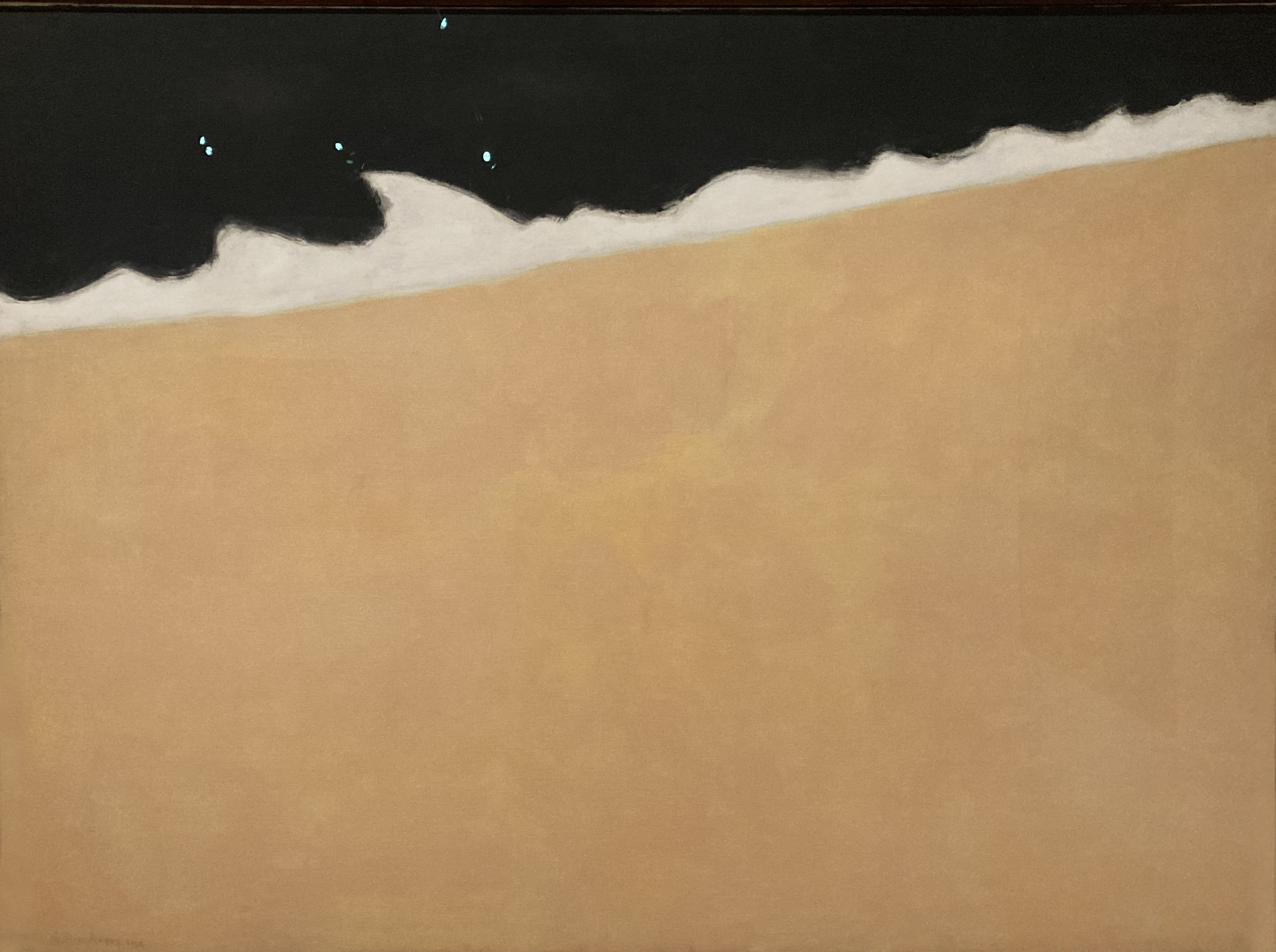
Milton Avery (1893-1965) was famous for simplifying forms.  He refined and refined them in search of their poetic core.

I love his painting of a spring orchard:


Here are two of his paintings of the sea shore at night:


Avery tugs and plays with the shapes of nature to discover lyrical forms that no one else sees.  For example, this is his view of an industrial gas tank on the island of San Tropez:


Since Avery takes the liberty to reinvent nature's forms, he must decide exactly where to draw the line.  Watch him explore:


Three different attempts to figure out just how far to go.


His drawing is a neat little reminder for artists in the new year:  until you've gone too far, you'll never really know if you've gone far enough.

Wishing you all a happy, healthy 2024!


Tuesday, December 19, 2023

A TRIP TO THE SOCIETY OF ILLUSTRATORS

 Every time I visit Manhattan I make a beeline for the Society of Illustrators which, pound for pound, remains one of the most interesting galleries to visit in the city.  Many pictures there are not to my taste, but I never fail to learn from and be inspired by their varied assortment of art on display.

Here are some particularly excellent images I want to point out to the world:

This huge, juicy watercolor by the talented Bill Joyce reminded me that I don't revisit his work nearly enough.  Up close the painting just glows in ways that printed books-- or your computer monitor-- can't capture.  


Joyce's distinctive imagination shines through in every garment, every hairstyle, every pose, every architectural detail, every lighting effect.  This is a beautifully constructed painting.


The Society is also displaying Victor Juhasz's preliminary sketches leading up to his illustration for the short story, The Mailman, about a mousy little man provoked to violence. 


Milton Glaser warned students, "A designer who cannot achieve the specific image or idea he or she wants by drawing is in trouble."  For proof, look no further than what Victor Juhasz is able to accomplish with his excellent preliminaries for different ideas:


Juhasz can master extreme foreshortening to fit all the necessary ingredients into the picture, each with the right emphasis.  He knows exactly how to balance the weight of the figure in the pose he needs.

You want those figures drawn from above?  Yeah, Juhasz can do that too.

How would that shadow work from a different angle?  Under control.

Another extreme perspective: a knife's eye view of the situation.

It's a joy to watch a talented draftsman like Juhasz play with alteratives. Would you find comparable draftsmanship at the Museum of Modern Art?  Would MOMA even care that you can't?  

Here is the final approved illustration:


In a different vein, an exhibit of children's book illustrations displays, among others, the joyful work of Christian Robinson.  His inventive designs are always refreshing to the eye.  He is, in my view, this generation's successor to the greatest designer/illustrators, such as the Provensens.


And for one more example in a different category, kudos to whoever at the Society figured out that this mask by illustrator Wladislaw Benda needed to be lit from below, with a red background.


Benda is another excellent illustrator who seems to have slipped through the cracks, but in the 1920s and 30s he was as famous for his masks and costume designs as he was for his illustrations.

There you have it-- a selection of personal high points from the Society of Illustrators this week.  Always worth the trip.


Saturday, December 02, 2023

ARTISTS IN LOVE, part 23

 After last week's arguments over politics and war, we are overdue for another report on the curious doings at the intersection of art and love:

Norman Lindsay and Rose Soady

Artist Norman Lindsay said that he usually began his complex pictures by drawing a single female form, then built the rest of his composition around that central image.  Starting in 1902, the central figure in Lindsay's life was his favorite model (and later wife) Rose Soady.   


Sketch of Rose, 1905
 
In a dusty used bookstore I recently stumbled across Rose's memoir of her unconventional life with Norman.


Lindsay was married with children when Rose began modeling for him, but after two years Rose reports the two consummated their relationship "spontaneously and without premeditation," then stayed together for the rest of their lives.  She was apparently the rare woman who was scrappy and open minded enough to keep up with him.


Rose described the extraordinary measures the couple took to hide their scandalous relationship.  She lied to her mother about posing nude and Lindsay lied to his wife that he was sleeping in his studio. The couple lied to their landlady that they were brother and sister (but were sternly evicted when the landlady caught on). Later when the couple rented adjoining rooms, they cut a secret trap door in the wall so they could get together. 
The partition was only thin wood, which made entry from room to room easy-- just by cutting a trap door.  A saw and two hinges were all that was necessary for the job.  It was cut out just above floor level and the drawing table placed against the trapdoor; a chair, a mat, and a scatter of papers and books made it look just right to callers. 
But here's the interesting part:  despite their elaborate efforts to keep up pretenses, Norman's pictures of Rose seemed to be public advertisements for their affair.  Why even bother lying to their landlady if Norman was drawing pictures like this?


Lindsay became famous for his hundreds of pictures of wild nymphs and satyrs trysting.  


Artists who draw the most intimate or controversial subjects somehow feel shielded by their art.  It's like the child who thinks that if they put a napkin over their head, no one can see them.  

The artist's audience might suspect, but can't prove, where fact ends and fantasy begins.  This fig leaf often emboldens artists to put all kinds of revelatory and personal subject matter out there.  Once a picture has been launched, it becomes something separate from the artist, who-- if pressed-- can disavow any reality in the content.  

Where did the fact end and the fantasy begin?  Above, Norman's reference photo of Rose (reproduced in her memoir). Below, a fanciful drawing by Norman.


Of course, some friends and family were unwilling to abide by the polite fiction and stopped associating with Norman or Rose.  Shrill letter writers accused her of being a "tart."  Publications such as The Sydney Morning Herald and Art in Australia sponsored campaigns against Lindsay's work.  Art galleries and museums refused to exhibit Norman's work.  Angry clergy clucked at and scolded the couple.  

The feisty Rose tried to defend Norman's work, visiting hostile publishers and confronting critics who publicly attacked Norman while privately applauding his work.  Norman wrote:
A country that fails to understand that the moral value of Art has nothing to do with the ethics of suburban back parlours is not worthy of being given an art....[N]ot one specimen of the Moral Lion who is at present  roaring at my work has the faintest perception of its moral intention, or could, in a single instance, explain the meaning of one of the works he is making such a fuss about.
By 1913, when Norman drew Rose in the role of "Venus Crucified" by society's moral guardians, the jig was pretty well up:


Looking back, Rose seemed to relish her youthful adventures.  In her memoir she proudly reprinted some of Norman's [NSFW]  early photos of her.  "Those were the days," she recalled. 
 

Norman developed their personal photos himself using chemicals in their small kitchen.  Rose recalled that the chemicals smelled terrible, but apparently the results were worth it.


Norman passed away in 1969, and Rose followed him in 1978.