I always wondered if his painting meant that Schwartz felt trapped in his career as a commercial artist.
Friday, October 28, 2022
DANIEL SCHWARTZ EXHIBITION
Sunday, October 23, 2022
CRIMES AGAINST ART, part 2: MARY RICHARDSON
I have tried to destroy the picture of the most beautiful woman in mythological history as a protest against the Government for destroying Mrs Pankhurst, who is the most beautiful character in modern history.... If there is an outcry against my deed, let everyone remember that such an outcry is an hypocrisy so long as they allow the destruction of Mrs Pankhurst and other beautiful living women, and that until the public cease to countenance human destruction the stones cast against me for the destruction of this picture are each an evidence against them of artistic as well as moral and political humbug and hypocrisy."
Richardson was imprisoned for six months, which was the maximum penalty under British law for destruction of an artwork.
As we've previously discussed on this blog, the ability to create great art is very rare, yet any moron has the ability to destroy it. Perhaps that's why accountants never make good artists: art's odds are so terrible, a career in art would make no sense to anyone who understands math.
Tuesday, October 11, 2022
CRIMES AGAINST ART, part 1: SCRANTON, PENNSYLVANIA
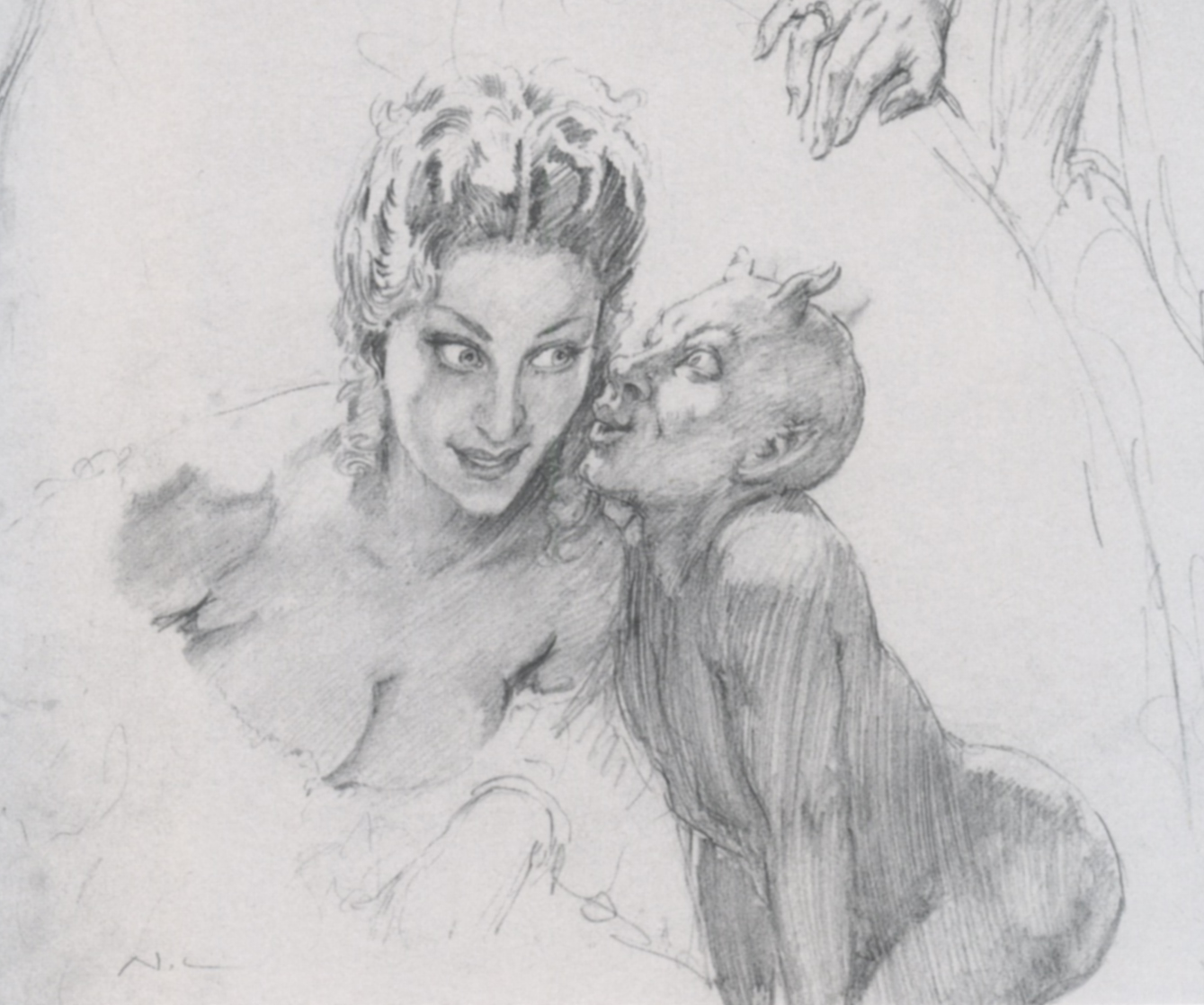
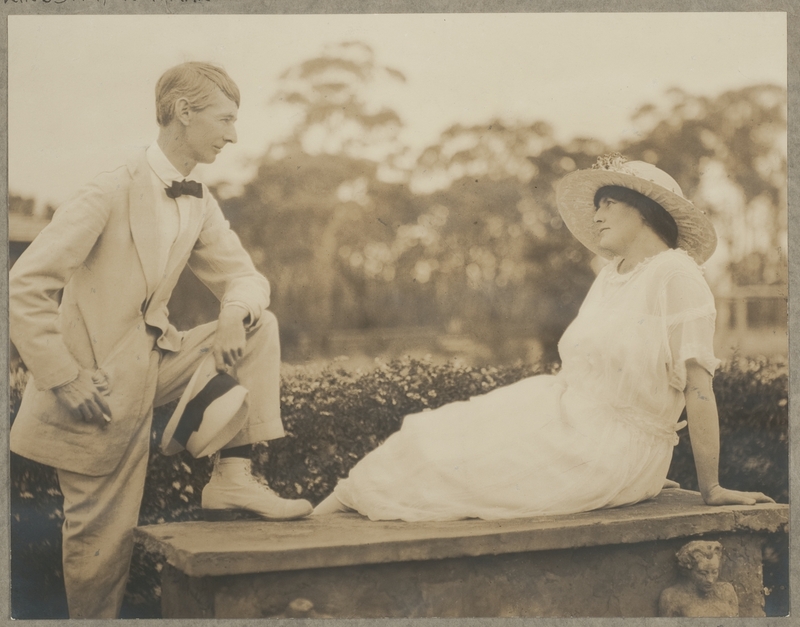
The Australian artist Norman Lindsay may have been the most randy illustrator of the 20th century.
![]() |
| Norman and Rose Lindsay |
Fearful that they would never return to Australia, Rose brought all of her prized possessions with her, including 20 years worth of Norman's best work. Her daughter Jane recalled, "Large crates were specially made and into them she packed everything which she cherished as beautiful and valuable-- hundreds of exquisite watercolours, pen drawings, etchings...."
The couple docked in California and made their way across the country by train. The crates with art were loaded onto a wooden freight car immediately behind the engine. When the train reached Pennsylvania the freight car caught fire. The train pulled off into the small town of Scranton where the good citizens helped put out the fire and saved as much of the art as they could on the train platform.
However, when they saw the scandalous pictures they had saved, the citizens became so upset that they piled up the artwork and and set it back on fire again "before corruption could set."
Lindsay's artwork survived a world war and a fire, but it couldn't survive the morality of the citizens of Scranton.
Friday, October 07, 2022
ANOTHER CHANCE AT PICTURE MAKING
![]() |
| Bundy sketching his daughter at home, circa 1947 |
![]() |
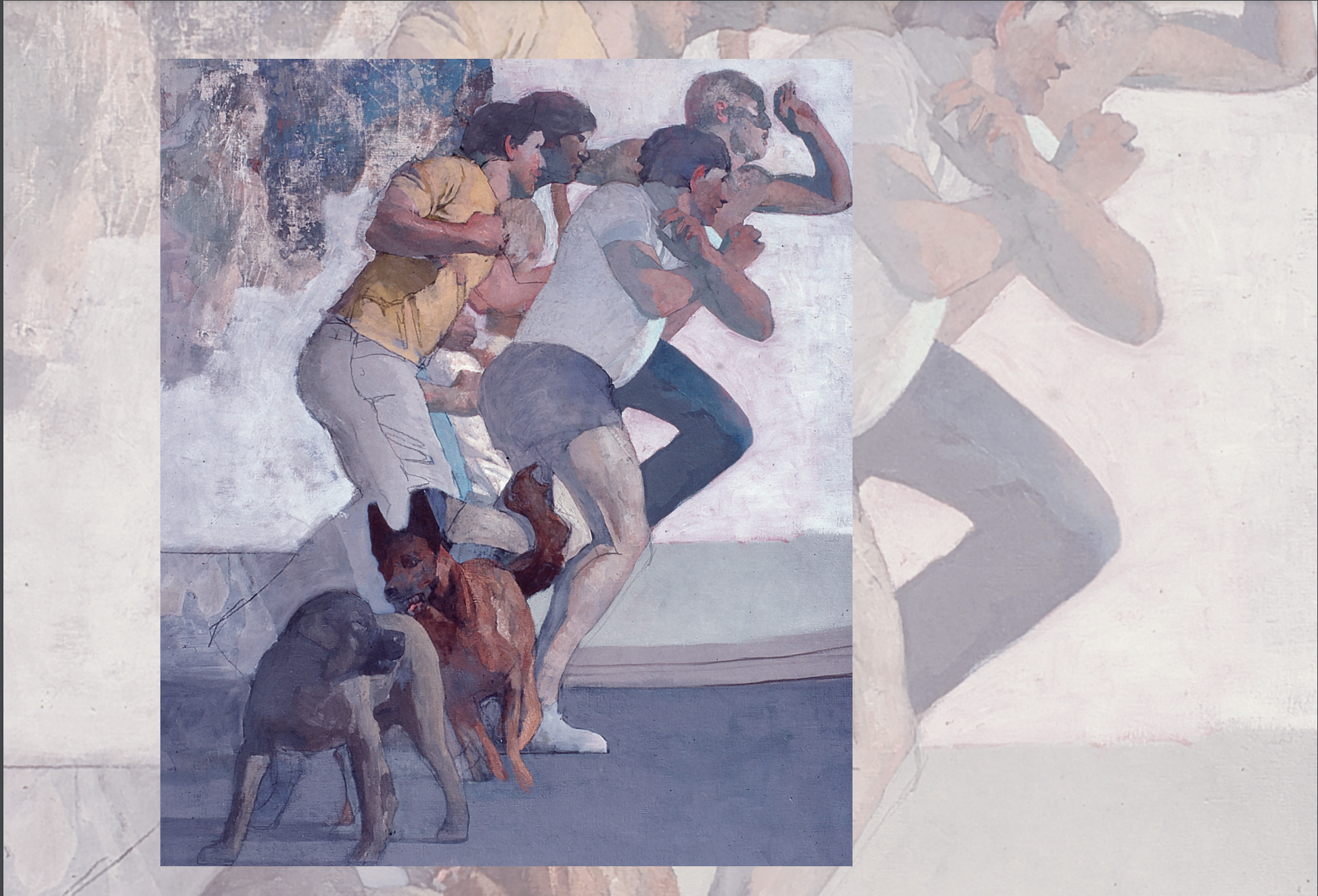
| The dog in front of the mural was named Emmett Kelly. |
... but it eluded his grasp. Bundy began drinking heavily. His daughter recalled hearing him weeping behind closed doors and threatening to commit suicide. One day he held her close and said, "War is never worth it." His marriage fell apart. He moved out and his wife painted over his mural, sealing that chapter forever.
Monday, September 12, 2022
DO AI ARTISTS DREAM OF ELECTRIC SHEEP?
Sigmund Freud claimed there have been three great shocks to the human ego:
- The discovery that the earth is not the center of the universe but is instead a tiny, vulnerable planet adrift in a cold and inhospitable universe.
- The discovery that humans descended from "a hairy, tailed quadruped" rather than being the divinely appointed progeny of Adam and Eve.
- The discovery that humans are not sublimely rational creatures, but are instead controlled to a disturbing degree by our unconscious and the spasms of our residual lizard brains
![]() |
| Tennessee farmer O.W. Wooden: "Trying to tell you people come from monkeys and all that stuff. Couldn't be right! Monkeys to me, like a chicken, you know?" |
Machine art has been rumbling like distant thunder for a long time. Photography, moving pictures, reproduction technology and Photoshop have all transformed our historical concept of art. They've reduced the difficulty (and therefore the mystery and value) of human skill. They've significantly altered some of the fundamental goals of art, putting an emphasis on concept rather than execution, substituting curation of images for creation of images (using a whole new vocabulary such as "appropriation art," "re-contextualization," "sampling" and "augmentation."). "Photo-illustration" has swallowed up whole categories of work that was once profitable for artists. Digital art, which can be infinitely reproduced in perfect copies, has attempted to restore uniqueness and authenticity with the artifice of NFTs.
None of these changes to traditional art would have occurred if traditional art wasn't forced to redefine itself in reaction to the boarding house reach of machine art.
Now artificial intelligence is rattling our door.
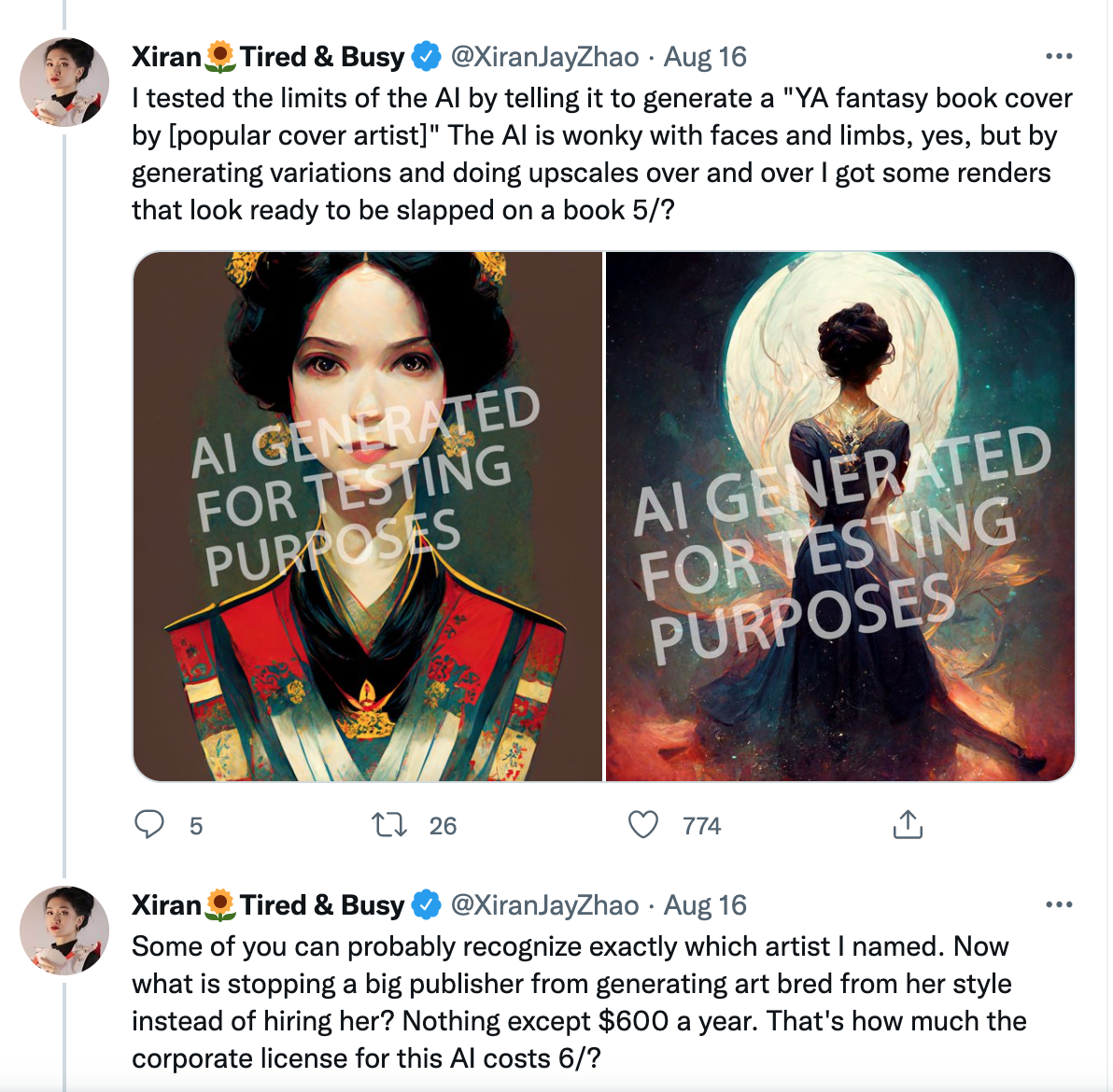
In the past year, affordable off-the-shelf AI software (such as MidJourney and DALL-E2 ) has empowered adolescents with no discernible talent to create images using words alone. If you know how to spell your illustration assignment, you can receive an offering of customized solutions within seconds. As one self-styled "AI artist" exulted: "I felt so liberated bc drawing is the one creative thing I can't do AT ALL but I have a lot of hyper specific art ideas...."
You can hear the "Yipeee!" echoing all across the internet.
Discussions about the significance of AI art now abound, including in the comment section of my last blog post. Predictably, a lot of the traffic on social media is precipitous as well as factually, legally and economically misinformed. Still it's not too early to grapple with the question: have we finally arrived at Freud's 4th great shock? If we attempt to deny it, are we any different from O.W. Wooden? And perhaps most importantly, if the 4th shock is indeed here, how can we define our creative species in a manner consistent with the new reality?
There is no single answer because art is not a single discipline. The shock waves from AI art will affect multiple artistic categories (economic, legal, educational, professional, and yes, creative) differently.
I think it's a mistake to take too much comfort from the fact that people with taste are still able to distinguish AI art from high quality human art. Any serious ontological analysis must take into consideration the growth trajectory of AI, and search for qualitative barriers that AI won't be able to cross in the future.
Pixar's ungainly CGI experiment, Tin Toy , came out in 1988. A mere seven years later Toy Story was released as a persuasive, full length CGI feature.
Tuesday, August 30, 2022
RALPH EGGLESTON (1965-2022)
This week the brilliant Ralph Eggleston, one of the joyful pioneers of modern animation, passed away before his time.
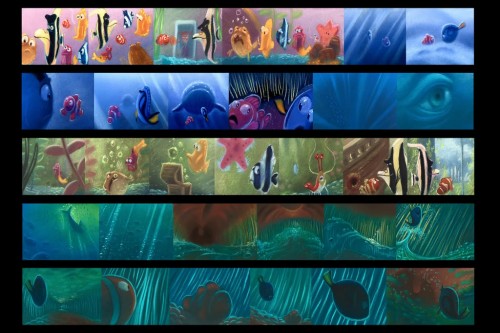
Eggleston was the art director for Toy Story, the first full-length computer animated film, as well as for The Incredibles and other films. He was also the Production Designer for one of my favorite animated films, the ingenious, poignant and lovely Wall-E. In his "color script" below, you can see Eggleston plan the movement of color and mood in the changing scenes of Wall-E:
In doing my artwork, the element of time is foremost in my thoughts... I approach visuals with the idea of burning into the audiences's retina as much information as is needed as clearly and quickly as I can so they can focus on the characters and the emotional content of the story they are being told.
Monday, August 22, 2022
ARTISTS IN LOVE, part 21
When illustrator Mead Schaeffer was a teenager, he fell in love with a girl in his art class, Elizabeth Wilson Sawyers. He nicknamed her "Toby" because she posed for illustrations for the book, Toby Tyler.
When Schaeffer turned 20, he quit art school (giving up his full scholarship) to marry Toby and start work. The couple moved into a 6th floor walk up in New York City where they formed a team.
Work was sparse and times became hard. Then Schaeffer landed his first big break-- illustrating the book Moby Dick-- for the publisher Dodd, Mead.
Years later on Christmas day he confided to his children that he nabbed that first project by snooping around the desk of the art director and discovering that the assignment was about to go to N.C. Wyeth. Schaeffer intercepted the project by volunteering to paint the first 6 illustrations for free. "If any of the staff did not like the work... all bets would be off and...they would owe me nothing." The startled art director agreed to the test and handed Schaeffer the manuscript. Schaeffer wrote about bringing that first manuscript home to his wife:
Toby became his model, consulted on the art, advised on his layouts, took reference photos and became the business manager for the team. Schaeffer began keeping a scrapbook of his work, and devoted the very first page to a large photograph of Toby.
By the 1970s, his classical, stately design and colors had been replaced by neon colors applied in an offbeat script on trendy paper. Apparently Schaeffer was trying to keep up with the times, even though he said,
The art of illustration has gone to hell, that's for sure.... I lived in the golden age. Now the photographer is more important than the illustrator. I'm not knocking photography but in my day you had to learn to draw better than they could take pictures.
For the graphologists in the audience, Schaeffer's lettering in his final years looks more feeble and uncertain. His outlines falter. But it seems the feelings he expressed remained undiminished.




,_1647-51,_01.jpeg)


.jpeg)