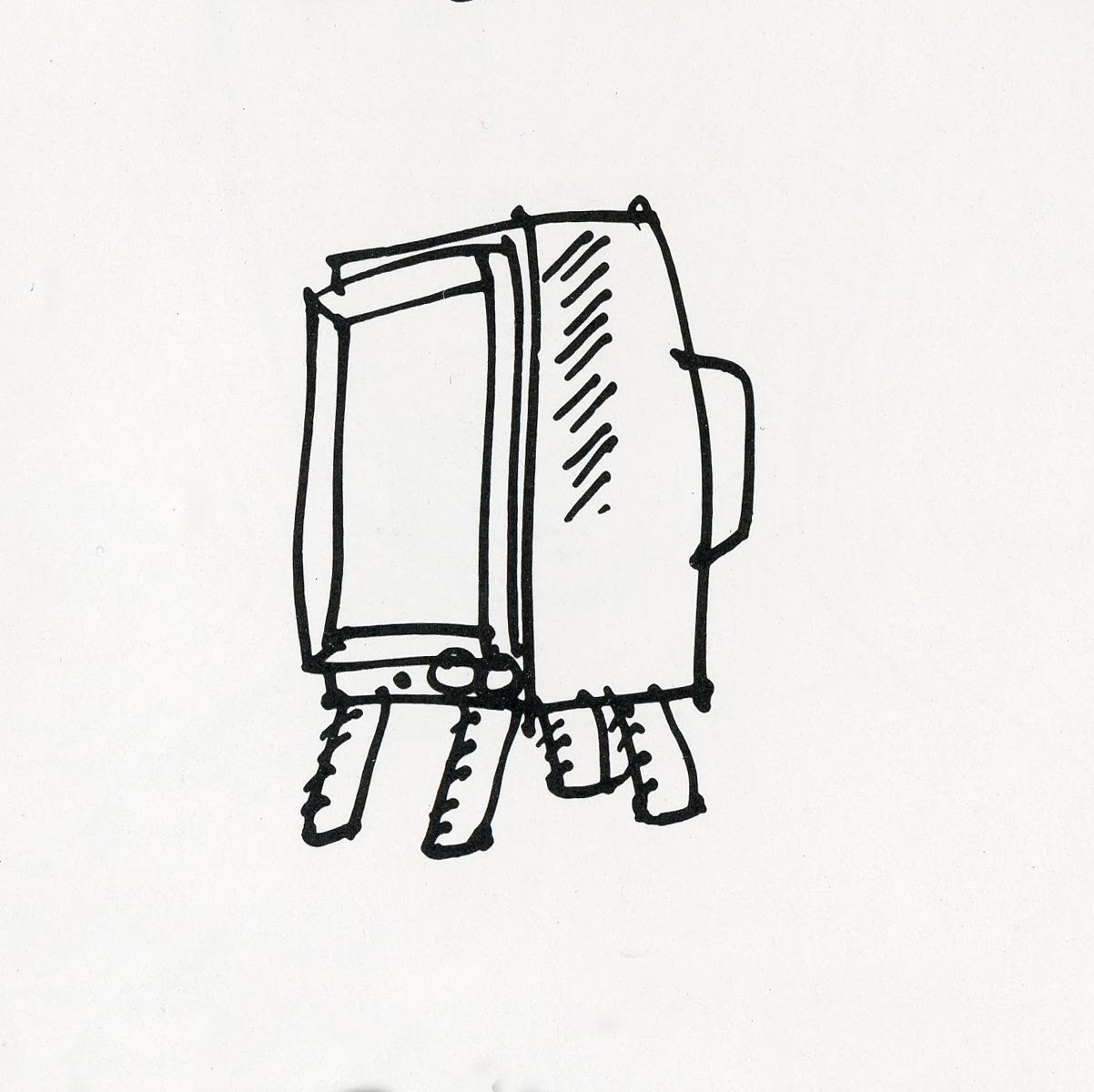
Here at the good ol' Illustration Art blog, we have great respect for words. However, every once in a while it's good to remind ourselves that pictures do thing that words cannot.
Lines can be fashioned into letters of the alphabet, or they can be set free to play in the wilder meadows of drawing. If lines are hardened into letters, their function becomes clear and unavoidable: to form words and sentences, marching
in straight rows, obeying the commands of their master, punctuation. But when a line is still free and retains its
original primordial wildness, it can do countless things in countless ways.
For example, you might use words to convey a message such as "television corrupts youth." But look at how the line of the great Lou Myers plays with the same theme:
You can't do that with words.
Lines that have been civilized into letters and words can
never return to their pagan state. Language is rule defined, so it becomes
unintelligible as it approaches chaos. But the lovely, wild line of art
remains at home in chaos.
Tuesday, November 26, 2013
Friday, November 15, 2013
ART IN PENULTIMATE TIMES
Yesterday, the 5th Annual Doomsday Clock Symposium was conducted by the Bulletin of the Atomic Scientists at the American Association for the Advancement of Science. During the Symposium, one of the lecturers shared Harold Edgerton's photographs of the world's first atomic explosion.
Edgerton, an MIT professor, received a top secret contract from the US government to film the first bomb test in the New Mexico desert in 1945, as well as several subsequent tests. He invented the rapatronic (Rapid Action Electronic) camera, with a shutter speed of just two milliseconds, to capture the very instant the nuclear blasts ignited. These ghostly images were taken from seven miles away in the desert to protect the camera from being incinerated:
Edgerton's photos remind me of Phil Hale's skull paintings:
As nuclear weapons proliferate, it becomes more difficult to run the calculations on the Great Actuarial Table and come up with a happy ending. After all, we can never un-learn the science of how to inflict catastrophic harm. That knowledge can only become more widely disseminated, easier to use and harder to prevent.
The math suggests we're living in penultimate times. What role can art play under such circumstances? Can it raise our consciousness? Humanize our attitude toward nuclear technology? Provide us with solace for what appears to be an inevitable fate?
Art and death have been best friends since the very beginning. Our mortality is one of the greatest inspirations for art. Yet, despite all the effort that generations of artists have spent contemplating individual death, they have never quite figured out how to react to death's ugly big brother, total extinction.
Oh sure, there have been pretenders along the way. The Black Death in Europe had the potential to end the world, and it inspired artists such as Bruegel, Bosch, Chaucer and Defoe.
However, the Black Death ultimately helped to usher in the Renaissance by breaking the grip of a repressive feudal system and an autocratic church, thereby awakening the modern western mind.
As another example, the genocide of World War II was pretty damn impressive. At the end of the war, Picasso (who had painted the slaughter at Guernica a few years earlier) visited the extermination camp at Birkenau where 20th century technology had been employed to massacre over a million people. He walked the camp in stony silence and left oppressed by the inadequacy of art.
That night he turned to his friends and muttered, "We had to come here to understand. To think that painters once thought they could paint 'The Massacre of the Innocents.'"
Until now, even the worst slaughters have been redeemed by the possibility that a surviving audience could bear witness to (and perhaps give meaning to) the tragedy. That slender consolation may no longer be available.
Artist Ralston Crawford was commissioned by Fortune Magazine to witness and illustrate one of the first atomic bomb tests in the south Pacific in 1946. Perhaps his senses were damaged by the blast, for he came up with this laughable reaction:
Another artist, Enrico Baj, sensed that the jig was up and urged in his manifesto that traditional painting be demolished and that art be re-invented to respond to the new reality. However, despite the sincerity of his intentions, his art was not up to the challenge.
Today an occasional museum exhibition will work up the nerve to take on this biggest theme of all. Artists such as Isao Hashimoto make their point effectively with hard data, while artists such as Carol Gallagher take a very personal and emotional approach and Jonathan Fetter-Vorm has prepared a graphic novel about the first Trinity explosion. Some of these efforts are more successful than others, but they are all well-intentioned.
The ancient Greeks tragedians understood that even a doomed person retains enough control to elevate his or her fate from mere misery to the dignity of tragedy. That's not much, but if it's the only way to extract salvation from despair, it's important.
Edgerton, an MIT professor, received a top secret contract from the US government to film the first bomb test in the New Mexico desert in 1945, as well as several subsequent tests. He invented the rapatronic (Rapid Action Electronic) camera, with a shutter speed of just two milliseconds, to capture the very instant the nuclear blasts ignited. These ghostly images were taken from seven miles away in the desert to protect the camera from being incinerated:
![]() |
| The beast Extinction, unchained for the first time |
Edgerton's photos remind me of Phil Hale's skull paintings:
As nuclear weapons proliferate, it becomes more difficult to run the calculations on the Great Actuarial Table and come up with a happy ending. After all, we can never un-learn the science of how to inflict catastrophic harm. That knowledge can only become more widely disseminated, easier to use and harder to prevent.
The math suggests we're living in penultimate times. What role can art play under such circumstances? Can it raise our consciousness? Humanize our attitude toward nuclear technology? Provide us with solace for what appears to be an inevitable fate?
Art and death have been best friends since the very beginning. Our mortality is one of the greatest inspirations for art. Yet, despite all the effort that generations of artists have spent contemplating individual death, they have never quite figured out how to react to death's ugly big brother, total extinction.
Oh sure, there have been pretenders along the way. The Black Death in Europe had the potential to end the world, and it inspired artists such as Bruegel, Bosch, Chaucer and Defoe.
![]() |
| The Triumph of Death by Bruegel |
As another example, the genocide of World War II was pretty damn impressive. At the end of the war, Picasso (who had painted the slaughter at Guernica a few years earlier) visited the extermination camp at Birkenau where 20th century technology had been employed to massacre over a million people. He walked the camp in stony silence and left oppressed by the inadequacy of art.
![]() |
| The front gate at Birkenau, circa 1945 |
Until now, even the worst slaughters have been redeemed by the possibility that a surviving audience could bear witness to (and perhaps give meaning to) the tragedy. That slender consolation may no longer be available.
Artist Ralston Crawford was commissioned by Fortune Magazine to witness and illustrate one of the first atomic bomb tests in the south Pacific in 1946. Perhaps his senses were damaged by the blast, for he came up with this laughable reaction:
Another artist, Enrico Baj, sensed that the jig was up and urged in his manifesto that traditional painting be demolished and that art be re-invented to respond to the new reality. However, despite the sincerity of his intentions, his art was not up to the challenge.
Today an occasional museum exhibition will work up the nerve to take on this biggest theme of all. Artists such as Isao Hashimoto make their point effectively with hard data, while artists such as Carol Gallagher take a very personal and emotional approach and Jonathan Fetter-Vorm has prepared a graphic novel about the first Trinity explosion. Some of these efforts are more successful than others, but they are all well-intentioned.
The ancient Greeks tragedians understood that even a doomed person retains enough control to elevate his or her fate from mere misery to the dignity of tragedy. That's not much, but if it's the only way to extract salvation from despair, it's important.
Friday, November 08, 2013
THE CHANGING ETIQUETTE OF THEFT
Recently a west coast illustrator was outraged to discover that her art had been used without her permission by a corporation, Cody Foster Inc., for a line of Christmas ornaments. The illustrator complained that the stolen art was "100% mine" and launched a publicity campaign attacking the plagiarism of her work.
The original works by the artist are on the left and the "copies" by the Cody Foster company are on the right:
However, during her publicity campaign it was discovered that the illustrator herself had "borrowed" someone else's copyrighted work to make her illustrations. The copyrighted photographs are on the left and the "copies" by the artist are on the right:
The artist's double standard is consistent with the slippery standards set by today's most successful master artists.
However, during her publicity campaign it was discovered that the illustrator herself had "borrowed" someone else's copyrighted work to make her illustrations. The copyrighted photographs are on the left and the "copies" by the artist are on the right:
For example, Jeff Koons repeatedly "borrowed" other people's images to create his masterpieces, but when he discovered someone borrowing from him, he became indignant and sued for copyright infringement. Similarly, Andy Warhol shamelessly "borrowed" images from others, but the Andy Warhol Foundation aggressively attacks anyone who attempts to copy Warhol's copies.
Apparently, the part of the human brain responsible for recognizing irony has atrophied as contemporary art has developed over the past 50 years.
In the 1960s, Pop artists such as Lichtenstein and Warhol regularly used images by other artists but slept soundly at night believing that, although their images looked nearly identical, the underlying "concept" was different.
Since the 1960s, the language of borrowing has become more glib, even as borrowing has become more blatant. The Museum of Modern Art sniffs,
In such a complex world, no wonder the etiquette of borrowing has become confusing.
There used to be a natural defense against appropriation; art required technical skill, and if you couldn't paint like Caravaggio, you couldn't appropriate his work. But in recent decades the need for technical skill has diminished while the ease of mechanical copying has increased. The historical barricades against appropriation quickly fell, along with the historical moral prejudices against it.
Today information technology indiscriminately captures vast oceans of images; it delivers them to us instantly from anywhere in the world, and empowers the least talented among us to duplicate them, alter them and even animate them in ways that the original artist would never permit. Our attitude toward these pictures has changed because Google Images, Tumblr and Instagram have led many to believe that untethered images buzz around randomly in nature, like subatomic particles. Today we seem to spend more time managing and tweaking pre-existing images than we spend creating important new ones.
In fact, a growing number of artists manage streams of digital information the way previous generations of artists managed pigment on a palette. Data is becoming the raw stuff of art, and the low challenge for the artist is to manage that data with just a little more taste and style than a search engine or data mining software might manage it.
The etiquette of borrowing will continue its radical transformation and it will be interesting to see where it ends up. But no matter what happens, one injustice is likely to remain unchanged: it will always be less of a crime for "fine" artists to steal from "commercial" or "low" artists (such as illustrators, commercial artists and cartoonists). Rather than condemn it, The Museum of Modern Art celebrates this phenomenon as "appropriated images from popular media and culture." Some things just don't change.
Apparently, the part of the human brain responsible for recognizing irony has atrophied as contemporary art has developed over the past 50 years.
In the 1960s, Pop artists such as Lichtenstein and Warhol regularly used images by other artists but slept soundly at night believing that, although their images looked nearly identical, the underlying "concept" was different.
![]() |
| Lichtenstein explained why his version (on the right) is not a copy: "What I do is form, whereas the comic strip is not formed in the sense I'm using the word...." |
Since the 1960s, the language of borrowing has become more glib, even as borrowing has become more blatant. The Museum of Modern Art sniffs,
The recontextualization of familiar images from television, film and advertising suggests that the meaning of those images might not be intrinsic and unchanging but rather culturally constructed and context specific.In addition to "recontextualization," borrowing has been justified as repurposing, transformative use, sampling, augmentation, or sometimes just plain old appropriation art.
In such a complex world, no wonder the etiquette of borrowing has become confusing.
There used to be a natural defense against appropriation; art required technical skill, and if you couldn't paint like Caravaggio, you couldn't appropriate his work. But in recent decades the need for technical skill has diminished while the ease of mechanical copying has increased. The historical barricades against appropriation quickly fell, along with the historical moral prejudices against it.
Today information technology indiscriminately captures vast oceans of images; it delivers them to us instantly from anywhere in the world, and empowers the least talented among us to duplicate them, alter them and even animate them in ways that the original artist would never permit. Our attitude toward these pictures has changed because Google Images, Tumblr and Instagram have led many to believe that untethered images buzz around randomly in nature, like subatomic particles. Today we seem to spend more time managing and tweaking pre-existing images than we spend creating important new ones.
In fact, a growing number of artists manage streams of digital information the way previous generations of artists managed pigment on a palette. Data is becoming the raw stuff of art, and the low challenge for the artist is to manage that data with just a little more taste and style than a search engine or data mining software might manage it.
The etiquette of borrowing will continue its radical transformation and it will be interesting to see where it ends up. But no matter what happens, one injustice is likely to remain unchanged: it will always be less of a crime for "fine" artists to steal from "commercial" or "low" artists (such as illustrators, commercial artists and cartoonists). Rather than condemn it, The Museum of Modern Art celebrates this phenomenon as "appropriated images from popular media and culture." Some things just don't change.
Monday, October 21, 2013
PHOTO REFERENCE FOR ITALIAN SUNLIGHT
Vacationing in Italy, illustrator Bernie Fuchs was struck by these shadows on the wall of a building. He took this photograph...
...which he later used as reference for this painting:
Fuchs squeezed colors into the painting that were nowhere in the original photograph:
The photo preserved important information, yet the special quality that Fuchs saw in the Italian light, and the hidden forms it revealed, did not come from a camera. They only emerged after Fuchs digested the photographic information and began his painting.
Fuchs was trained in traditional drawing and painting skills, without photographs. However, when he worked in a Detroit commercial art studio in the 1950s, he was visited by an illustrator from the famed Cooper Studios in New York who urged him to make more use of photography. The illustrator explained that all the top illustrators in New York were now relying on photo reference to satisfy modern client demands. He told Fuchs: "It makes no sense to paint the way you are doing it. You'll never be able to keep up with the competition." From that point on, Fuchs used his camera as a reference tool, especially in situations where he had no time to sketch or paint details:
My work on the upcoming book on Fuchs has heightened my appreciation for how Fuchs used photo reference. The parts of his paintings that mattered came from the artist, not the camera.
Note how Fuchs subsequently pushed those Italian shadows even further. He uses them as a vehicle for meditations on color, value and design.
In this final painting, the last residue of the photograph has been stretched and distorted. The shadows on the building have been completely stylized.
The old man hobbling off into the distance is Fuchs' invention.
...which he later used as reference for this painting:
Fuchs squeezed colors into the painting that were nowhere in the original photograph:
The photo preserved important information, yet the special quality that Fuchs saw in the Italian light, and the hidden forms it revealed, did not come from a camera. They only emerged after Fuchs digested the photographic information and began his painting.
Fuchs was trained in traditional drawing and painting skills, without photographs. However, when he worked in a Detroit commercial art studio in the 1950s, he was visited by an illustrator from the famed Cooper Studios in New York who urged him to make more use of photography. The illustrator explained that all the top illustrators in New York were now relying on photo reference to satisfy modern client demands. He told Fuchs: "It makes no sense to paint the way you are doing it. You'll never be able to keep up with the competition." From that point on, Fuchs used his camera as a reference tool, especially in situations where he had no time to sketch or paint details:
![]() |
| Fuchs photographing President Kennedy in the oval office |
![]() |
| Fuchs photographing the action at a sports events for Sports Illustrated |
Note how Fuchs subsequently pushed those Italian shadows even further. He uses them as a vehicle for meditations on color, value and design.
The old man hobbling off into the distance is Fuchs' invention.
Thursday, October 10, 2013
ARTISTS AT WAR, part 4
L. J. Jordaan (1885-1980) was a powerful graphic artist and political cartoonist in Amsterdam for the magazine, Green. He drew a biting series of anti-Nazi cartoons during the 1930s. After the Nazis invaded the Netherlands, they promptly shut down his magazine but Jordaan continued working underground and for alternative publications.

![]() |
| Dictating to the newspapers (wearing handcuffs) about what they can print. |
![]() |
| Stealing into the Netherlands by the back door... |
As the tide turned against the Nazis later in the war, Jordaan gleefully recorded their misfortunes:
In the end, Germany lay in ruins and Green published the following illustration of "the hangover of Brunhilde," the German valkyrie who had become drunk on Nazi lies. The collar on the cat in the window says "retribution. "
![]() | ||
| Note the graves on the hill. |
In addition to his job as a political cartoonist, Jordaan was a journalist and a musician. After the war he changed careers and became a well known film critic.
I think his images, drawn in the face of political opposition, were strong and evocative. His work deserves a broader audience than it has had.
Thursday, October 03, 2013
SIMPLER IS BETTER
No backgrounds.
No clothes.
No photo reference
No fingernails or eyelashes.
No light source.
No facial expressions
No laws of anatomy that can't be compromised in the name of design.
No place to hide.
Rodin's watercolors: Absolutely marvelous.
No clothes.
No photo reference
No fingernails or eyelashes.
No light source.
No facial expressions
No laws of anatomy that can't be compromised in the name of design.
No place to hide.
Rodin's watercolors: Absolutely marvelous.
Thursday, September 26, 2013
ARTISTS IN LOVE, part 19
I share Roberta Smith's views about the special quality of drawing:
Drawings are the most overtly delectable of all art forms...Drawings in general are like love letters. Personal in touch and feeling, physically delicate, they reflect the artist's gifts, goals and influences in the most intimate terms... [They are] a direct extension of an artist's signature and very nervous system.Some drawings turn out to be more intimate than others. Take for example the secret drawings of Malcolm McKesson (1909 - 1999).
McKesson was not a professional artist. Heir to a pharmaceutical company fortune, he grew up with privileges and attended the best private schools. But he was a fragile soul and had a hard time surviving in the business world. At a debutante party he met Madelaine Mason, a strong willed poet. He married her and gradually withdrew from society to devote himself to a life as her full time servant.
![]() |
| "I am Chastened." |
McKesson said he was in awe of the "the strength and wisdom of the female" and wished he could be a woman, if "only for a day."
McKesson and Madelaine were married for 48 years before she passed away. During that time, nobody knew much about their private life together. We would still know nothing today if McKesson had not drawn thousands of pictures about their relationship.
McKesson wrote and illustrated a little manuscript entitled Matriarchy: Freedom in Bondage. Wiki summarizes the plot as follows:
Matriarchy follows the sexual transformation of Harvard undergraduate Gerald Graham, who willingly subjects himself to the authority of the stern Lady Gladys. She teaches him to "curb his manly nature" by forcing him to take on the role and costume of a lady's maid named Rose. The house is a matriarchy because, as Lady Gladys explains, "in this house all things feminine are blessed, all things masculine are bound in slavery."
. . . .
Gerald's first transformation into Rose is described thus: "From a closet she removed some padded silken forms. These were strapped tightly to his shoulders and waist, adding a more feminine shape to his thighs, breasts and buttocks. In this upholstery Rose was indeed a proper woman prepared to assume the black dress, the slip and the elegant apron of a serving maid."
Measured by traditional standards, McKesson's amateurish pictures may not appear to be great drawing. We don't see sensitive lines or decisive, telling strokes; there is no real economy or vigor here. Instead, these pictures are comprised of thousands of worried little circles, overlapping and repetitive, turning around and around on themselves.
In this sense, they are the "direct extension of an artist's... very nervous system" that Roberta Smith described. To the extent that McKesson was cringing and dithering, those characteristics are embodied in his line. To the extent he was obsessive, that too shows up in these densely inked pictures where McKesson went back over his images again and again in little circles. We are witnessing drawing as an extension of the sex act.
Drawings need not be skillful to have merit. I think these drawings do a marvelous job of portraying McKesson's personality. You can almost smell the rooms where these scenes took place, with heavy curtains drawn.
For me, the following drawing is easily as compelling as anything R. Crumb ever did. It gains power from an ambiguity that R. Crumb lacks.
![]() |
| I love that immense leg coming in from the right |
Subscribe to:
Posts (Atom)