Wednesday, November 30, 2016

AUSTIN BRIGGS RETURNS TO WHERE HE STARTED

Austin Briggs was 19 and still in art school when he sold his first drawing to Collier's magazine. 


Briggs soon decided he didn't need more school.  He was making good money from Collier's imitating the popular artists of the day.  But after a couple of years Briggs realized that he was faking it.  Many of his lines were just random squiggles with little understanding of what went on beneath the surface.  He was borrowing solutions he hadn't earned, and his shortcuts began to betray him.


His assignments started to dry up.  He'd never learned to paint.  Desperate for money, he quit the field of illustration.  He took other jobs, but all the while he was determined to go back and do it right: "I set about learning to draw, which I never could do before."

Briggs' son described this turning point in his father's life:
I see how correct he was in his mature assessment of his early work: he could not really draw, but with sheer vitality he faked his way to renderings that conveyed power and authority.  When the new demand for color illustration left my father in the Depression virtually without work and with a wife and two small children to support, he would not quit.  Taking his easel and sketch pad out of the studio, he began to look at the world-- to really see it.  Over God knows how many long hours of work, he taught himself until he eventually developed great skill as a colorist and as a draftsman....
Looking back, Briggs recalled:
These were experimental years; I explored new compositional approaches, new techniques or variations of old techniques and new manners of working with limited means. The fees I received from my drawings were largely plowed back into my work.... This was my chance to learn, and I worked over drawings until they were as good as I thought I could make them.  
Briggs learned to draw and to paint with great skill:


Then his art got looser...
And even looser:


Briggs became a dominant force in American illustration of the 20th century.  His strong, opinionated work covered the full gamut of the illustration field, from pulps and comic strips to the movie industry to the covers of books, records and top magazines.  

But the thing that interests me most about this story was that, at the height of his powers, having invested years in mastering painting and color theory, Briggs returned to simple drawing where he started.  As he became more fearless, he no longer needed fancy paints or even inks.  He simplified down to a pencil or a litho crayon.  Art directors for prestigious magazines were happy to accept a drawing from Briggs where once a full color oil painting would've been expected.  Briggs became famous in the industry for a remarkable series of drawings that he did for TV Guide, which were cited when he was inducted into the Illustration Hall of Fame:


Image courtesy of Taraba Illustration Art


If you compare Briggs' later drawings with his early random squiggles, you get a sense for how much he learned.   In the words of T.S. Eliot:
We shall not cease from exploration.  And the end of all our exploring will be to arrive where we started and know the place for the first time. 


Saturday, November 19, 2016

PEOPLE WASN'T MADE TO BURN


In 1948, Ben Shahn illustrated an article for Harpers Magazine about the murder trial of James Hickman.

Hickman worked the night shift in a Chicago steel mill to support his wife and seven children.  The family lived in a tiny attic in a tenement slum, in one of the few neighborhoods where African Americans were permitted to live under Chicago's racially restrictive zoning rules.  Hickman wanted to move out of his apartment but his landlord refused to return Hickman's security deposit.  The landlord warned tenants that if they raised problems, he knew "a man" who would come burn them out of their homes.

On the night of January 16, 1947, Hickman was working at the mill when his apartment caught fire.  The apartment was unsafe, with no exits, fire escapes or extinguishers.  His children were trapped inside.  When he returned the next morning his neighbor said, "Mr. Hickman, I hate to tell you this, four of your children is burnt to death."  They found the body of Hickman's 14 year old son under the bed, futilely trying to shield three of his younger siblings from the flames.


The Chicago police made no serious effort to investigate the landlord.  As months went by, the anguished Hickman, devoutly religious, obsessed more and more about the babies that he'd lost, and the lack of justice in the world.  He muttered to himself, "Someday they would have married, someday they would have been fathers and mothers of children...."


Eventually Hickman got a gun.  Following God's instructions, he killed the landlord.  For the first time, the  Chicago police felt motivated.  They promptly arrested Hickman who freely admitted what he'd done, saying, "Paper was made to burn, coal and rags, not people.  People wasn't made to burn."

The prosecutor charged Hickman with first degree murder.  He was surely headed for the gallows, but then the story took an unusual  bounce.  The other tenants in Hickman's building angrily organized into the Chicago Area Tenant's Union and combined with the Congress for Racial Equality (CORE) to publicize the case and support Hickman.  An outraged public rose up.  The ACLU defended Hickman and the jury refused to convict him.  

Harpers Magazine hired the distinguished journalist John Bartlow Martin to write about the trial, and renowned artist Ben Shahn to illustrate the story.  Shahn remained haunted by what he had learned about the case, and after completing the illustrations, he went on to create a larger, more allegorical painting about the tragedy.  Shahn transformed the fire into a flaming wolf / lion creature, with the children lying dead at his feet. 


Unfortunately, some officials-- already suspicious of Shahn's support for racial equality-- became concerned that the red beast might symbolize communism.  Henry McBride, writing for the New York Sun, argued that Shahn should be "deported" for his "pro-communist painting."

Shahn was indeed a socially conscious artist; he had previously participated in the WPA, where he worked with other artists who were interested in creating an American art that reflected the lives of ordinary people.  The following image, by another WPA artist, gives us insight into crowded urban life in the '30s for people of that class.


One critic noted that after the social injustice of the Great Depression and the existential threat of World War II had subsided,  former WPA artists became less interested in a representational, humanistic style:
Artists had to apply for WPA positions.  They were paid between $23 and $35 a month to produce a set amount of work every week.  "There were a lot of women participants... and it was very overtly welcoming to African-Americans....."  Perhaps because there was so much collaboration-- or because the artists wanted to keep their patron, the WPA, happy-- most of the prints remained representational and accessible.... "very focused on the present and engagement with the human experience.... The WPA officially disbanded in 1942, although artists continued to work in that style through Word War II.  But after the war, notions of art changed.  "The project developed a national identity that pulls away from the personal....After the war, artists reacted against it with abstract expressionism....It was a natural pendulum swing, I think, a reaction to the ways the WPA didn't speak to individual artists."        
Since the post war era, much of fine art has been self-absorbed and self-referential.  But it appears that there may be many opportunities for artists to play a socially conscious role in the years ahead.  It will be interesting to see how the art community responds.
_________________________

PS-- In 1948 the Supreme Court finally ruled that the racially restrictive covenants which had kept Hickman and other African-Americans confined to a narrow stretch of dilapidated, rat infested apartments were unconstitutional.  Here's hoping that the new appointments to the Court don't have a change of heart.


Thursday, November 10, 2016

FRANK GODWIN IN COLLIER'S IN THE 1920s

Some of the finest ink drawing was created in the late 19th and early 20th centuries in response to the invention of the modern magazine.  The popular new medium created a huge demand for black and white images in the years before reliable color printing.  Just one of the new magazines, Life, employed an average of 25 different pen and ink illustrators each week.

A group of well known illustrators such as Charles Dana Gibson, James Montgomery Flagg, Joseph Clement Coll and Orson Lowell developed the craft of ink drawing for the new market.  But there were dozens of other highly skilled, less remembered illustrators whose work for these magazines deserves attention.  

Frank Godwin is mostly known for his popular comic strip in the 1950s but back in the 1920s he was a regular contributor to Collier's magazine.


Look at how magazines were chock full of drawing back then. 


Prior to the introduction of full color the highest medium of expression in these magazines was line work with pen, brush and ink.  As usual, constraint inspires creativity.

A lot of excellent drawing is buried back in those archives.


Tuesday, November 01, 2016

WARRING WITH TROLLS, part 9: SPECIAL ELECTION EDITION

"To live is to war with trolls."    -- Ibsen

Congressman George A. Dondero (Republican from Michigan) was convinced that art is a communist plot.   In a 1949 speech to Congress he explained how art undermines the morals of America:  
As I have previously stated, art is considered a weapon of communism.... It is a weapon in the hands of a soldier in the revolution against our form of government.... The evidence of evil design is everywhere....  The question is, what have we, the plain American people, done to deserve this sore affliction that has been visited upon us so direly; who has brought down this curse upon us; who has let into our homeland this horde of germ-carrying art vermin?...
 (From the Congressional Record, First Session, 81st Congress, Tuesday, 16 August 1949.)

Dondero carefully analyzed how each school of modern art contributes to the destruction of America:
1.  Cubism aims to destroy by designed disorder.
2.  Futurism aims to destroy by the machine myth
3.  Dadaism aims to destroy by ridicule.
4.  Expressionism aims to destroy by aping the primitive and insane.
5.  Abstractionism aims to destroy by the creation of brainstorms.
6.  Surrealism aims to destroy by denial of reason.  
Dondero and his fellow patriots were particularly agitated about art by immigrants (or "germ carrying art vermin") invading the United States:
LegĂ©r and Duchamp are now in the United States to aid in the destruction of our standards and traditions.  The former has been a contributor to the Communist cause in America; the latter is now fancied by the neurotics as a surrealist.... 
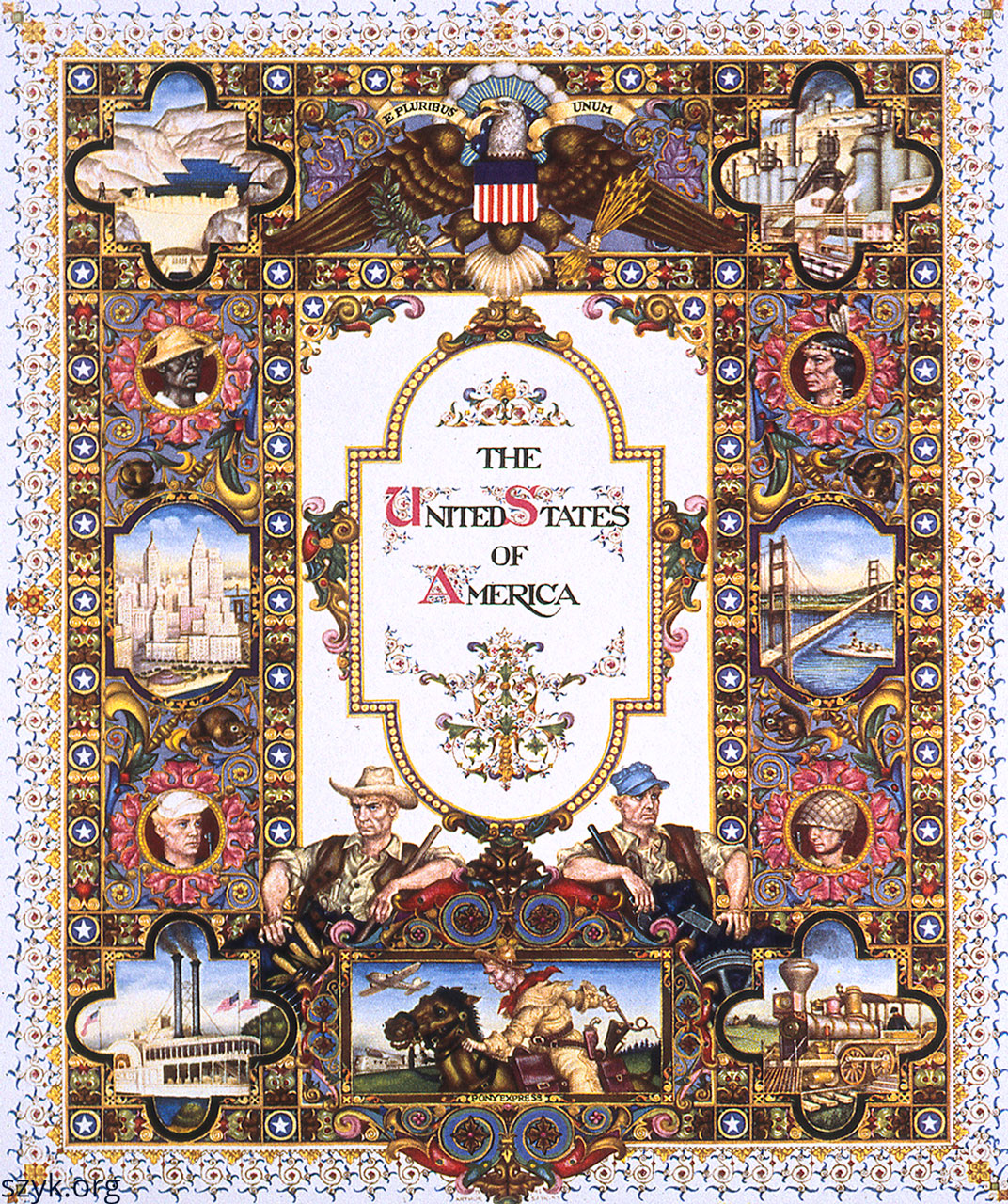
Other Congressmen on the House Un-American Activities Committee in 1951 were similarly concerned about immigrant art vermin, such as artist Arthur Szyk.  Szyk had escaped from Hitler in 1939 and came to the United States, where he became a relentless propagandist against the Nazis.


His cartoons infuriated Hitler, who put a large price on Szyk's head. Eleanor Roosevelt welcomed him as a "one man army" for his adopted home.  Szyk created many drawings and paintings praising America's  freedoms:


However, after the war ended certain Congressmen became suspicious that anti-fascist immigrants might also harbor Communist sympathies.  They launched an investigation of Szyk in April 1951. Although Szyk vehemently denied any affiliation with communism, the old and frail artist died of a heart attack four months into his investigation, on September 13, 1951.

It's ironic that while Congressman Dondero was fulminating about threats to the country from modern art, the CIA was secretly subsidizing abstract art as part of the cold war against the Soviet Union.   It was spending substantial sums weaponizing modern art by Jackson Pollock, Willem de Kooning and Mark Rothko as part of a culture war, while Dondero and his fellow patriots were defusing the CIA's work.  

Ironically, Stalin (sounding very much like Congressman Dondero) railed against modern art, which he called "ideological sabotage against our country and especially against our youth...." Stalin complained that
attempts are being made against socialist realism in art and literature.... In these so-called abstract paintings there is no real face of those people, whom people would like to imitate in the fight for their peoples’ happiness, for communism and for the path on which they want progress. This portrayal is substituted by the abstract mysticism clouding the socialist struggle against capitalism.


Thursday, October 27, 2016

LIT FROM WITHIN

An art critic once remarked that when Rembrandt was young and cocky, his portrait subjects were dramatically lit from the outside, but as he got older and wiser, his subjects became lit from within.

Rembrandt self-portraits at age 23...  and at age 53
Very few things in the world actually emit their own light-- angels, fireflies, suns-- the rest of us are opaque objects, only visible because we reflect the light from those rare sources.

That hasn't stopped artists from trying to imbue opaque surfaces (such as paper or canvas) with radiance, to suggest that their subject glows from within.  In the middle ages, texts were called "illuminated" when artists used gold or silver to make them glow.  Today we can illuminate images electronically using light-emitting diodes or simply turning up the brightness on our computer monitor. This makes colors glow in a way that Rembrandt never dreamed.

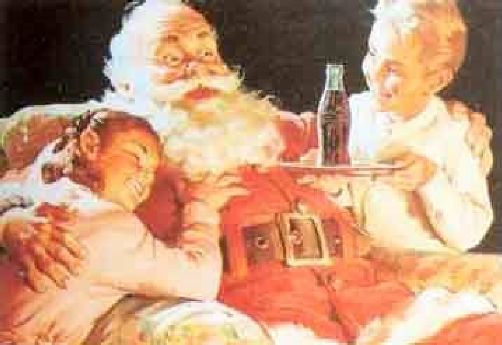
Some commercial illustrators of the 20th century turned that "lit from within" feeling into a personal brand.  Haddon Sundblom was famous for creating a Santa Claus that radiated sunshine.


Another talented illustrator, less well known than Sundblom, was Pete Hawley.  He painted cute babies on greeting cards and little plastic plaques that grandmothers hung on their kitchen walls in the 1950s.


His assignments were largely simple minded, yet he did beautiful work.


Note how his colors and technique combine to give his subjects an incandescence:


Highlights from above on their hair and reflected light on their cheeks from below were ethereal pinks and turquoises.


As an aside, I love Hawley's snappy brushwork which adds contrast and vigor to the brim of her straw hat, or to the shape of his mechanic's cap.


Sundblom and Hawley didn't have the luxury of lighting their subjects electronically. Today anyone can flip a switch and give a face more lumens than Rembrandt ever did.

But a picture that literally glows is not the same as a picture that glows metaphorically.  Sundblom and Hawley used their considerable arts and artifices to simulate a feeling of radiance.  Their goal was not just to make colors brighter but to give Santa Claus a magical, radiant smile or surround a praying child in celestial light.  In the autumn of his life, Rembrandt could give his face the sadder glow of embers after the original bonfire of his youth had subsided.

Their illusion of light was achieved with a combination of skills and talent on behalf of an artistic purpose, and those don't come with an electric switch, at least not yet.

Friday, October 21, 2016

"I'M FREE! HELP!"

In Richard Thompson's comic strip, Cul de sac, a guinea pig escapes from a school classroom.  Once outside, the pig says:


What does he mean by that?

The famous poet Stephen Crane pointed out that we'd better be careful about wishing for freedom:
If I should cast off this tattered coat,
And go free into the mighty sky;
If I should find nothing there
But a vast blue,
Echoless, ignorant --
What then?
Thompson never wrote poetry about existential dread but he was able to make the same point using humor, children and talking animals.   Crane's words wouldn't fit in a tiny word balloon, but Thompson effectively grabs our attention by juxtaposing the simple words "I'm free!" with "Help!"

Last week we discussed whether comics are a suitable medium for profound content.  As a general matter, I'd say no.  Comics are short, simple, cheap, badly reproduced and aimed at a low readership.  Most are poorly drawn.   It's difficult to make great art using a medium that chafes and strains against ambitious content.

But every once in a great while, an artist comes along who vindicates the medium by achieving greatness within its confines.  Gifted artists such as Herriman, Schulz, Watterson or Thompson, have the rare ability to simplify larger human truths into brief adventures squeezed to fit in small boxes.

Thompson's brief strip about the guinea pig makes Stephen Crane's point, but in a lighter more elegant way than Crane.  As a bonus, he makes other funny observations about human nature along the way:  


I love the evanescent loyalty of the children:


Like Herriman, Thompson drew with "secret grace and obvious clumsiness."
As St. Augustine said (and as Thompson also shows us) "the virtue of children lies not in their wills but in the weakness of their limbs."

When Thompson's children grow up, they'll develop the guile to conceal their true natures.  But cartoons don't allow room to gradually strip away artifice, so great cartoonists use children to distill grown up truths to their essence.


Thursday, October 13, 2016

THE DUMBEST TIJUANA BIBLE I EVER SAW

When R. Crumb illustrated Bible stories in comic book form, some critics complained, "the power of the text seems diminished, not enhanced or illuminated, by these images." If the pictures don't enhance the text, what's the point?

Crumb himself said, "I decided just to do a straight illustration job." For example, he portrayed God as the traditional old white guy in a toga with a long beard.  He even gives us the perfunctory starburst to symbolize the creation of heaven and earth.
 

I would've enjoyed seeing Crumb's demented imagination applied in earnest.  Instead, he handled the Bible "just like [the Classics Illustrated comic books from the '50s]. You know, it's no big deal." 

You might wonder why the world needs another comic book version of the Bible, a book which raises the world's most challenging and complex subjects.  After all, there are plenty of versions out there already for lazy students seeking a study guide the night before exams. Do any of these illustrations contribute anything original on the subjects of creation, mortality, sex, destiny, spirituality, love, passion, miracles, etc.?  From the Classic Comics version to the Kubert version to The Graphic Canon treatment to The Action Bible, the graphic novel format seems to dumb down, rather than enhance, the text.

As Mario Naves wrote, "An artist who trades in trivialities should know well enough not to mess with themes that are beyond the scope of his talent."

Which brings me to the new book, Garden of the Flesh, biblical stories by Gilbert Hernandez. [CAUTION: EVEN WITH MY REDACTIONS THE FOLLOWING IMAGES ARE NSFW.] 

According to the cover, "Beginning with Adam and Eve and continuing through the story of Noah's ark," this book offers "biblical tales of Original Sin."  Inside is perhaps the most barren treatment of the Bible or of sin I've ever seen.


What in the world was the artist thinking?  These awful drawings-- flat, bland and unimaginative--together with the sparse, inane dialogue suck the IQ points right out of your head.


(N.B.: I promise these are not unfair excerpts.  The entire book limps on like this, page after page.)


If these drawings had been scratched on a men's room wall I'd say, "go for it!"  I agree with the wise man who said, "Bad drawing, even bad bad drawing, almost always has character.... the vision has a weird purity you kind of have to admire, no matter what."  But bad drawing loses some of that "weird purity" and no longer deserves the benefit of the doubt as it become more pretentious.

Today we're all good post-modernists; we evaluate pictures based on the artist's success at achieving his or her individual ambitions.   But that doesn't mean we have no standards whatsoever.  A book that is essentially a Tijuana Bible at heart gets evaluated differently when it takes on the ambitions of a deluxe embossed book which presumes to address Biblical stories of original sin.  It's hard not to feel insulted by this book.

Authentic Tijuana Bibles may not get reviewed in prestigious journals but they are superior works of art, more successful at achieving their artistic ambitions. 


Many of the artists who drew Tijuana Bibles were technically unskilled but their drawings were more genuine and human and lusty than the thin, pleasureless drawings in Garden of the Flesh.  

Not only that, but their plots were more intelligent.

John Dillinger stops to aid two pretty girls who are having car trouble.


Thursday, September 29, 2016

DRAWINGS THAT STILL AROUSE EMOTIONS

Can drawings still inflame passions today?

Anyone who doubts it should've attended the annual convention of the American Association of Editorial Cartoonists last week in Durham, North Carolina.  Editorial cartoonist Ann Telnaes (of the Washington Post) described how she was swamped with outraged phone calls, emails and tweets  after drawing a negative cartoon about Ted Cruz.


Some of the comments she received were later quoted in The Columbia Journalism Review:
“You filthy kunt…a baseball bat to your head is now due."
“HOW FUCKING DARE YOU CUNT. GET THE HELL OUT OF THE BUSINESS…”
“Bitch, your days are numbered.”
“do the world a favor, go hang yourself”
“I hope you get raped to death”
It's a good thing Cruz's followers are so religious; otherwise those comments might've turned nasty.

Cruz supporters helpfully posted Telnaes' photo online so she'd be easier to identify.  In the face of this lunatic rage, the Washington Post chickened out and removed the cartoon from its web site, thus vindicating angry jerks everywhere.

Cartoonist Joel Pett (of the Lexington Herald Leader) told a similar story.   He entertained the AAEC audience by playing his voice mailbox filled with enraged calls about Pett's cartoon criticizing Kentucky governor Matt Bevin: 


The attack on Pett was boosted by right wing social media and went viral.  At one point Pett did a little dance onstage to the soundtrack of crazed callers threatening him with harm.

I checked with conservative cartoonist Scott Stantis (The Chicago Tribune) to see if he received similar hate mail from the left.  He described how a reader called his home to say that he hoped Stantis's children would be killed.  There are morons on both sides of the political spectrum, many of whom have trouble reading complex words but who understand (and resent) the power of pictures.

Once upon a time, editorial cartoons were thought to make a difference by educating the public and showing them perspectives that might change their minds or soften their positions.  Cartoonist Thomas Nast was credited with helping to bring down the corrupt Tweed regime that controlled New York in the 1860s and 70s.  His graphic symbols resonated with the public (he created popular icons, such as the Republican elephant and Democratic donkey) so much that he influenced presidential elections.  Tweed is reported to have cursed, "Stop them damn pictures! I don't care what the papers write about me. My constituents can't read, but they can see the pictures."

Judging from this year's AAEC convention, fewer readers today are interested in being educated and more are interested in reinforcing their pre-existing biases.  To achieve this, many seem intent on silencing opposing views.  Ironically, these are the people who need education the most.  People who once were embarrassed by their own ignorance seem willing today to take aggressive steps to preserve it.

In such a climate, my hat is off to today's editorial cartoonists.

Wednesday, September 21, 2016

RESPECT FOR ROCKS

Why did Maxfield Parrish spend so much time painting tiny crevasses in rocks in the backgrounds of his paintings?


Parrish was a fabulously successful illustrator.  He earned over $100,000 per year in an era when houses cost only $2,000.  His time was so valuable, you'd think he would've found a shortcut for the menial labor of painting tiny crevasses in dumb rocks. 


To get the proper "feel" for rocks, Parrish used to bring actual rocks into his studio, paint them a flat color and 
light them to accentuate their shadows.

The following detail from an original Parrish painting, photographed from 3 inches away, shows you how tedious it must have been for Parrish to paint all those damn crevasses:


Obviously Parrish decided that these details made an important contribution to his paintings, and that there was no simpler, faster way to achieve the effect he wanted.
 
Bernie Fuchs was another great illustrator whose time was very much in demand.  He was an economical painter who abhorred unnecessary detail.  Yet, he too seemed to believe that rocks in the background were worthy of his sustained attention.


There's nothing fake about these rocks; they required thousands of deliberately placed brush strokes.  If Fuchs tried to get away with random marks, we would've seen the difference.


This is not an issue of mere realism.  Fuchs wove more design into the details than Parrish did, but that was Fuchs's nature.


It's not necessary to paint rocks in great detail to be persuasive.   Illustrator Harold von Schmidt simplified desert rocks using black poster paint and a wide, flat brush:


Von Schmidt grew up spending a lot of time staring at rocks in the desert.


Like Parrish and Fuchs, Von Schmidt respected background rocks and put substantial thought into getting them right. As a result, they gave themselves to him in these wonderful drawings.

On the other hand,  when even talented painters disrespect rocks and attempt to fake it, as Frank Frazetta did in these two pictures, the rocks end up looking phony:


Frazetta put in the manual labor to draw tiny cracks in this wall but you can tell he wasn't looking at rocks when he did

Just like the rest of mother nature, rocks don't like being taken for granted.